The new plan rejects some of Gov. Newsom’s proposed cuts to active transportation funding.


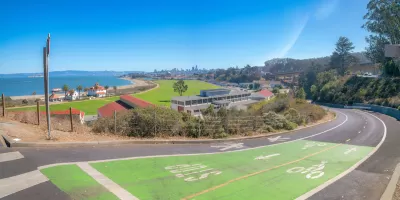
The California state legislature is pushing back on Governor Newsom’s proposed budget, countering proposed cuts to active transportation and safe streets programs.
As Melanie Curry explains in Streetsblog California, the legislature’s plan creates a “Projected Surplus Temporary Holding Account” that would hold off on disbursing projected surplus funds until it’s clear they will materialize. Instead of cutting the Active Transportation Program by $1 billion as the governor proposed, the plan proposes funding it from the State Highway Account, which advocates say should more heavily fund multimodal transportation projects.
“In terms of public transit, the Governor had proposed delaying $2.1 billion for the Transit and Intercity Rail Capital Program (TIRCP) from 2021-22 to later years, and cutting it by $148 million.” The legislature’s plan rejects the cut, but supports the proposed delay and the change of the funding source from the state’s general fund to the Greenhouse Gas Reduction Fund (GGRF). The legislature’s plan also supports the governor’s proposal to delay Zero Emission Transit Capital Program funding.
Nonprofit NextGen California expressed concern that both proposals signal “the end of California’s brief effort to expand climate investments beyond last decade’s zero-sum approach,” saying the shifts to GGRF funding amount to “cuts to the state’s total level of climate investment.”
Read the full story: Legislature Rejects Governor’s Proposed Cuts to Active Transportation, Intercity Rail

San Diego budget axes multimodal team at DOT
The budget scales back funding for some bike lane and traffic safety projects that are already in the works.
The Best Complete Streets Policies in the US, Ranked
San Antonio and Nashville top the list, with most large cities not making an appearance in the top 40.
‘Complete Streets’ Webpage Deleted in Federal Purge
Basic resources and information on building bike lanes and sidewalks, formerly housed on the government’s Complete Streets website, are now gone.

Planetizen Federal Action Tracker
A weekly monitor of how Trump’s orders and actions are impacting planners and planning in America.

Amtrak, CN end decades-long dispute with eight-year agreement
The new operating agreement establishes an updated framework for the companies to work together, including processes to resolve disputes.

Judges permit Denver to divert 77,000 acre feet from the Colorado River for reservoir expansion
Overuse and climate change have caused the Colorado River’s water levels to plummet.

NYC DOT wants faster, more permanent street upgrades
The city is examining ways to build more concrete infrastructure without getting entangled in 'decades-long' projects.

'Something we’ve never seen before:' rising utility rates could strain city finances nationwide
Data centers, climate change and other factors have caused utility rates in the United States to increase by 38% since 2020.

Trump to overrule local leaders, lease millions of acres of America’s Pacific Island territories’ seafloors to mining companies
International law says that the Indigenous people of America’s territories have a right to prior and informed consent regarding projects that impact their countries.

FREE Course: Walkable City 1: Why Walkability?
After describing his path towards focusing on walkability as the essence of good planning, Jeff Speck marches through his five principal reasons for making more walkable places.
Reinventing Malls: Planning Alchemy—Turning Gray Fields Into Gold
The course focuses on the opportunities and imperatives that shape reinvention of mall sites.

Harvard University Graduate School of Design
KFH Group Inc.
Greater Baltimore Committee
The Architects Foundation
University of Cincinnati Online
The Pocatello Development Authority
The Urban Renewal Agency of the City of Pocatello