U.S. and Canadian officials revealed plans for an electric vehicle charging network that will connect Kalamazoo and Quebec City with EV chargers every 50 miles.


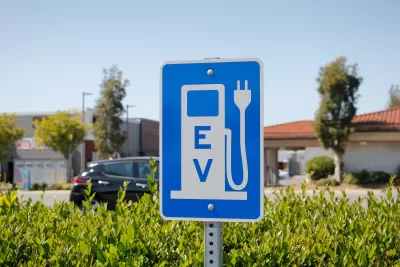
At a press conference in Detroit on Tuesday, U.S. Transportation Secretary Pete Buttigieg, along with his Canadian counterpart, Michigan Gov. Gretchen Whitmer, and Detroit Mayor Mike Duggan announced plans for a 872-mile “binational electric vehicle corridor” that would feature EV fast chargers every 50 miles and pass through two major historic production centers for the car industry.
As Eric D. Lawrence, explains in Detroit Free Press, “Tying the corridor to current investments in electric vehicles pushed by the Biden administration, officials said the plan would boost domestic manufacturing, strengthen supply chains and provide good-paying jobs while supporting U.S. and Canadian climate and alternative energy transportation goals.”
The press conference did not reveal the timeframe for the project, which would stretch from Kalamazoo, Michigan to Quebec City. “Funding, at least in Michigan, is tied to $110 million being received through the National Electric Vehicle Infrastructure Program and the federal Bipartisan Infrastructure Law passed in 2021.”
Read the full story: Buttigieg, Whitmer pitch EV corridor with Canada

Making The Switch To EVs Requires Robust Charging Infrastructure
With more states outlawing the sales of gas-powered vehicles and the federal government setting ambitious electrification goals, now is the time to invest in critical charging infrastructure.
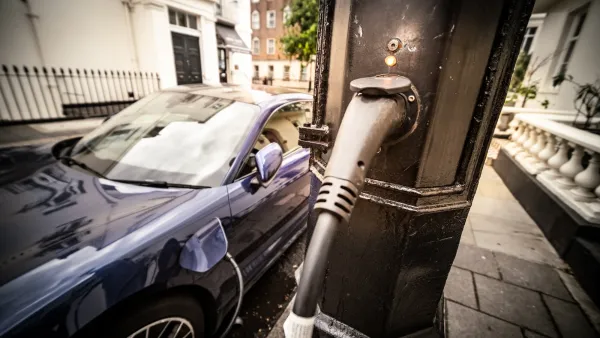
DC light poles will soon charge your electric car
The city awarded three grants to companies that will install more publicly available EV chargers.
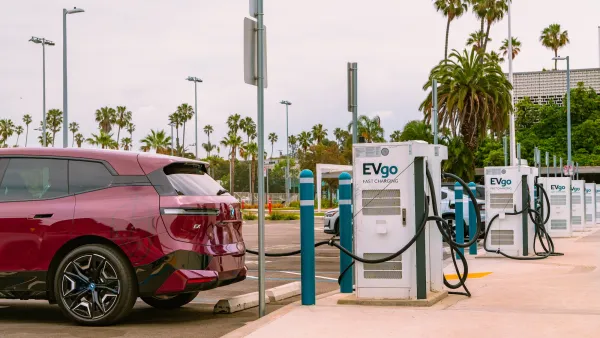
California Beats EV Adoption Goal by Over 1 Million Vehicles
The state pledged to put 1.5 million EVs on its roads by 2025.

Planetizen Federal Action Tracker
A weekly monitor of how Trump’s orders and actions are impacting planners and planning in America.

Eastern Nebraska is running out of electricity
Data centers and electrification are straining eastern Nebraska’s grid, throttling economic development.

Washington state to charge fee to drivers with fuel-efficient cars
Revenue from the fee will go towards supporting the state’s highways.

Instead of building new housing, LA developers are turning mansions into mega-mansions
In the richest areas, the number of houses valued at $30 million with demolition permits has skyrocketed since 2018.

Illinois considers spending $1 billion in taxpayer money on data center
A quantum computing campus and data center are currently under construction in Chicago.

As development costs rise, Boston moves to lessen affordable housing requirements
The Boston Zoning Commission and the City Council still need to approve Boston Mayor Michelle Wu’s proposed changes

FREE Course: Walkable City 1: Why Walkability?
After describing his path towards focusing on walkability as the essence of good planning, Jeff Speck marches through his five principal reasons for making more walkable places.
Reinventing Malls: Planning Alchemy—Turning Gray Fields Into Gold
The course focuses on the opportunities and imperatives that shape reinvention of mall sites.

City of Charlotte
City of Rosemead
Rutgers University, Edward J. Bloustein School of Planning and Public Policy
University of Michigan School for Environment and Sustainability (SEAS)
Hunter College, City University of New York (CUNY)
The Architects Foundation
City of Cambridge
The Pocatello Development Authority
The Urban Renewal Agency of the City of Pocatello