The city council will vote on a proposal to lower speed limits to 25 miles per hour to improve safety and make downtown more walkable and welcoming to pedestrians.


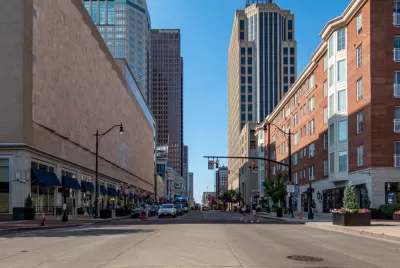
Downtown Columbus could see its speed limit lowered to 25 miles per hour if the city council approves a proposal at this Tuesday’s meeting, reports Mark Ferenchik in The Columbus Dispatch.
According to Ferenchik, “The Downtown streets where speed limits would be limited to 25 mph are in an area bounded by Interstate 670 to the north, Interstate 71 to the east, Interstates 70 and 71 to the south, and the Scioto River and Neil Avenue to the west,” as well as part of the Scioto Peninsula.
The new rule would lower the speed limit from 35 miles per hour, a decrease that is shown to drastically reduce the risk of serious injury and death in crashes involving pedestrians. “Officials in Austin, Texas, studied intersections in that city where similar changes were made and found an 18% reduction year-to-year in the number of pedestrians hit by left-turning vehicles at Downtown intersections.” The plan must be approved by the Ohio Department of Transportation (ODOT) to move forward.
As part of its Vision Zero goal, the city also plans to adjust traffic light timing to slow traffic and change light timing at some intersections to give pedestrians a head start when crossing. The changes would align with the strategic plan developed by the Columbus Downtown Development Corporation, which calls for a more walkable downtown.
Read the full story: Columbus City Council considers setting speed limit on all Downtown streets at 25 mph

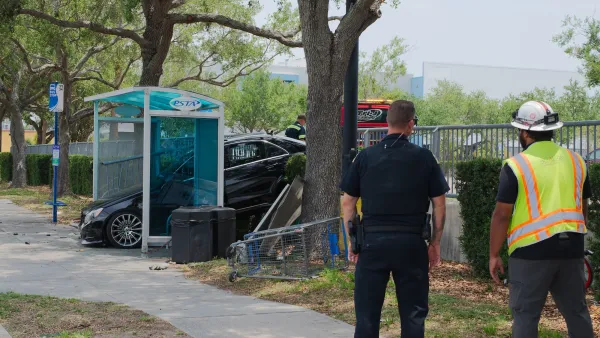
Buses are very safe. The walk to and from stations, not so much.
A disproportionate number of crashes involving pedestrians happen near transit stops.
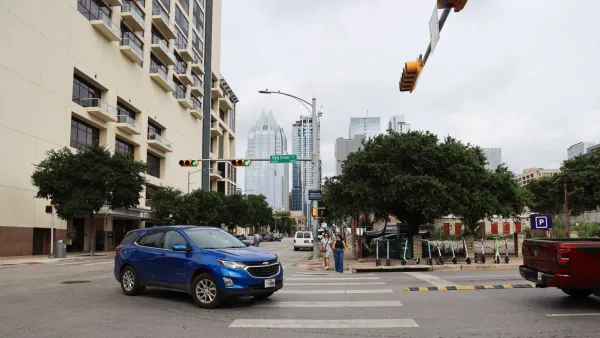
Austin ‘Turn Calming’ Cut Pedestrian-Involved Left Turn Crashes by Nearly Half
A pilot program at 16 intersections led to a dramatic reduction in injury crashes and is saving residents roughly $3 million in emergency response and medical expenses.
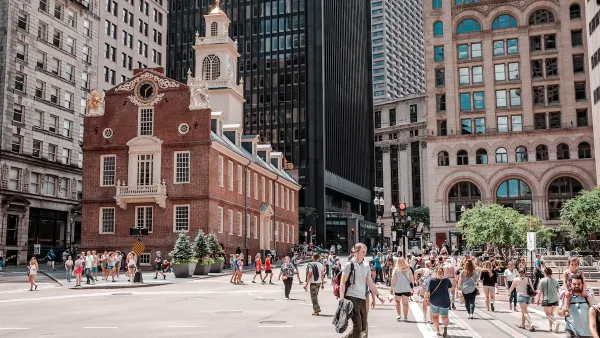
Report: Top US Cities for Pedestrian Safety
The East Coast takes the top three spots, while the South and Southwest dominate the bottom of the list.

Planetizen Federal Action Tracker
A weekly monitor of how Trump’s orders and actions are impacting planners and planning in America.

The state-sanctioned urbicide of Austin
People don’t kill cities. Freeways do.

US to reduce Colorado River water deliveries to Mexico
A new Colorado Treaty amendment reduces Mexico’s Colorado River water allocation by 250,000 acre feet.

Nation's most wind-powered state turns to coal as data centers increase energy demand
For the first time in decades, Iowa has increased its generation of coal power.

NYC cools commuters with city's first rain garden above a bus stop
New York City officials say the plants in the rain garden can absorb 16 gallons of rainwater during heavy storms.

Brightline West’s future may rely on $6 billion federal loan
The company has until Nov. 2 to make a $400 million equity investment into its proposed high-speed rail line.

FREE Course: Walkable City 1: Why Walkability?
After describing his path towards focusing on walkability as the essence of good planning, Jeff Speck marches through his five principal reasons for making more walkable places.
Reinventing Malls: Planning Alchemy—Turning Gray Fields Into Gold
The course focuses on the opportunities and imperatives that shape reinvention of mall sites.

Greater Baltimore Committee
Eagle County Government
Harvard University Graduate School of Design
The Architects Foundation
University of Cincinnati Online
The Pocatello Development Authority
The Urban Renewal Agency of the City of Pocatello
Journal of the American Planning Association