A proposal before Cincinnati's city council would boost traffic calming initiatives and use innovative technology to slow traffic on some of the city's most dangerous streets.


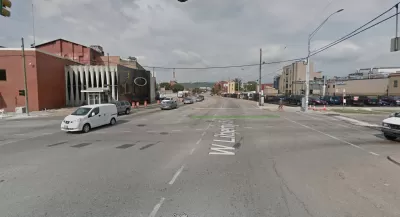
After a year in which 300 pedestrians were struck by vehicles and seven killed in Cincinnati, Cameron Knight reports that the city could boost its traffic safety programs with additional investment in traffic calming, if a proposal co-sponsored by Councilman Mark Jeffreys and Mayor Aftab Pureval passes.
"Department of Transportation and Engineering Director John Brazina said the $1 million injection doubles the current budget for pedestrian safety. Ten neighborhoods were planned to see improvements this year, but now 30 will be included in the project."
The plan includes installation of four types of devices, including "speed cushions," a speed bump that accommodates emergency vehicles driving at full speed while slowing regular cars. "The next two devices – slow turn wedges and hardened centerlines – are meant to force drivers to make sharper turns at intersections. This should slow drivers down because they won't be able to make sweeping turns at higher speeds. The devices also push drivers to enter further into the intersections before turning, giving them better visibility."
The fourth device is being dubbed "artistic bump-outs," writes Knight. This initiative would cut the cost and deployment time of bump-outs, which usually cost $80,000 to $100,000 per set, according to Councilman Mark Jeffreys. "Neighborhoods will have the ability to stylize and decorate the bump-outs in unique ways."
If approved by the city council, the proposal would use funding from the American Rescue Plan Act to support 30 projects around the city.
Read the full story: Cincinnati's $1 million pedestrian safety measure would use new ideas to slow traffic
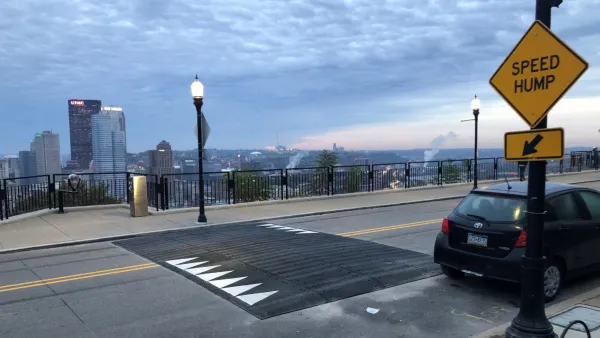
Pittsburgh Excels at Low-Cost, Quick-Build Traffic Calming
The city’s traffic calming initiative has led to a 6 percent average reduction in speeds on corridors with recent interventions.
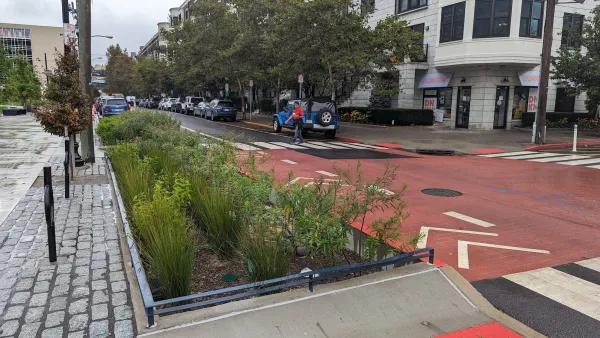
Hoboken's $20 Vision Zero fix
The New Jersey city eliminated traffic deaths for the last nine years in a row.
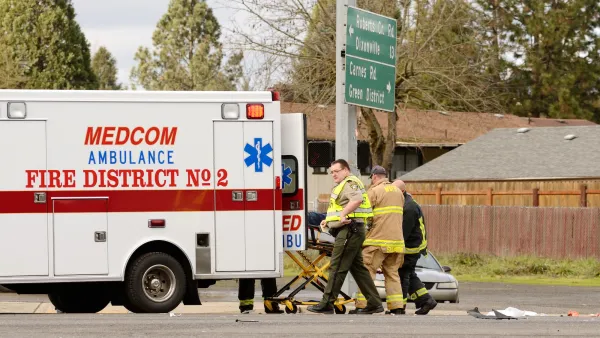
'Dangerous by Design' 2026 report highlights 72% increase in pedestrian deaths since 2009
Although US traffic deaths dropped in the last two years, the number of people killed on US roads remains much higher than two decades ago.

Planetizen Federal Action Tracker
A weekly monitor of how Trump’s orders and actions are impacting planners and planning in America.

California plans to bury El Niño’s downpour
If the state plays its cards right, it may be able to store a billion acre-feet of El Niño’s water in aquifers.

Desperate measures: Advocates weigh draining Lake Powell to fill Colorado River
Draining the reservoir could reduce evaporation losses by a couple hundred thousand acre-feet.

Chicago voters approve permanent festival grounds, penalty for vacant property owners
Currently, major summer and fall festivals take over public parks for weeks at a time, drawing criticism from nearby residents

NYC votes to cut outdoor dining red tape, speed up permitting
New York City also voted to allow the Department of Transportation to begin work on urgent projects before notifying elected officials.

California appears to reject Prop. 45
The proposition would have expanded the projects that qualify for a streamlined environmental review, effectively paring down the California Environmental Quality Act.

FREE Course: Walkable City 1: Why Walkability?
After describing his path towards focusing on walkability as the essence of good planning, Jeff Speck marches through his five principal reasons for making more walkable places.
Reinventing Malls: Planning Alchemy—Turning Gray Fields Into Gold
The course focuses on the opportunities and imperatives that shape reinvention of mall sites.

City of Rosemead
Rutgers University, Edward J. Bloustein School of Planning and Public Policy
One Hundred Miles
Hunter College, City University of New York (CUNY)
The Architects Foundation
University of Cincinnati Online
City of Cambridge
Montrose County
The Pocatello Development Authority