State legislators' refusal to pass HSR funding will return hundreds of millions slated for active transportation and other projects to the state's general fund.


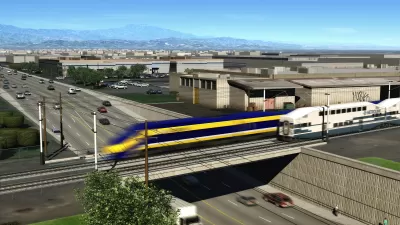
When negotiations over California High-Speed Rail funding stalled last week, reports Melanie Curry, "a number of unrelated programs that were slated to receive some of the general fund surplus will not get that funding." This includes $500 million for active transportation, $2.5 billion for the Transit and Intercity Capital Rail Program, $200 million for Climate Adaptation Planning Grants, and $100 million for Climate Adaptation Projects in the State Highway Operation and Protection Program.
As we reported earlier this month, "Governor Newsom requested $4.2 billion, the total left from $9.9 billion in bond funding approved by voters in 2008, but 'Assembly Speaker Anthony Rendon and other Democrats have argued for directing the money to other urban transportation projects.'"
This means that "[t]he California High-Speed Rail Authority likely won’t get access to the rest of the money approved by voters in 2008 until next year at the earliest. Lawmakers trying to get more money for regional projects in their districts will also have to wait." Staff for the Active Transportation Program "were poised to allocate extra funds to projects that have already applied, scored highly, and were not awarded money because there wasn’t enough in the program."
"While it’s possible that, come January, these funds might be revived, there’s no telling whether the state will continue to enjoy a surplus like it did in this unpredictable year."
Read the full story: High-Speed Rail Impasse Means No Active Transportation Boost, Other Projects Also Denied Funding
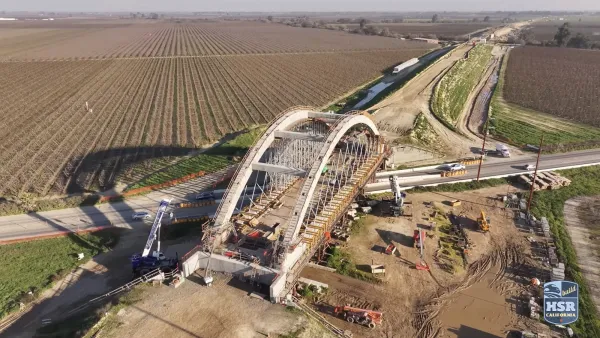
California High-Speed Rail wants to leverage data center revenue to fund trains
By positioning the rail line as a tech and renewable energy corridor, the agency hopes to increase revenue opportunities.
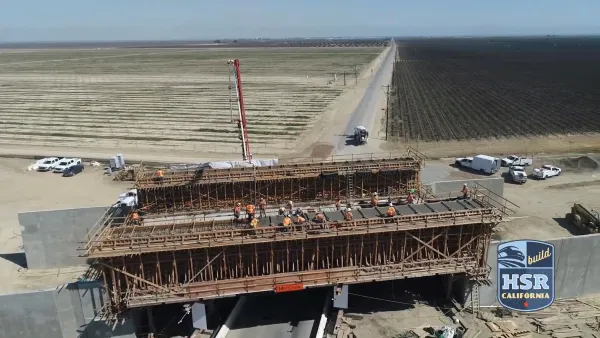
California High-Speed Rail Slashes $1.7B From 2026 Budget
The CHSRA plans to complete the Central Valley segment of the line and begin revenue service as soon as possible.
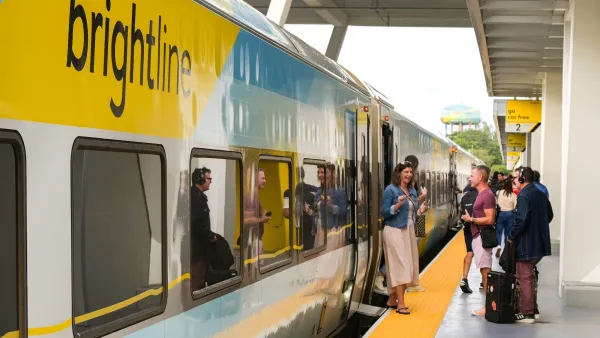
Brightline’s Bond Rating Lowered to ‘Junk’ Status as Debt Mounts Despite High Ridership
The high-speed rail operator faces a $1.2 billion debt load and has never turned a profit since it launched in 2017.

Planetizen Federal Action Tracker
A weekly monitor of how Trump’s orders and actions are impacting planners and planning in America.

California plans to bury El Niño’s downpour
If the state plays its cards right, it may be able to store a billion acre-feet of El Niño’s water in aquifers.

Desperate measures: Advocates weigh draining Lake Powell to fill Colorado River
Draining the reservoir could reduce evaporation losses by a couple hundred thousand acre-feet.

US buildings threatened, destroyed by fires set to triple by 2060
Researchers found a high fire risk for socioeconomically vulnerable neighborhoods in the American West.

LA residents may be allowed to paint their own crosswalks
Councilwoman Katy Yaroslavsky put out a motion instructing the Los Angeles Department of Public Transportation to study the feasibility of allowing volunteers to paint crosswalks.

Dallas moves to overhaul its zoning code
The city's zoning reform will allow more multi-family and mixed-use developments.

FREE Course: Walkable City 1: Why Walkability?
After describing his path towards focusing on walkability as the essence of good planning, Jeff Speck marches through his five principal reasons for making more walkable places.
Reinventing Malls: Planning Alchemy—Turning Gray Fields Into Gold
The course focuses on the opportunities and imperatives that shape reinvention of mall sites.

City of Rosemead
Rutgers University, Edward J. Bloustein School of Planning and Public Policy
One Hundred Miles
Hunter College, City University of New York (CUNY)
The Architects Foundation
University of Cincinnati Online
City of Cambridge
Montrose County
The Pocatello Development Authority