While the affordable housing discussion focuses on New York City among the many cities with public transit service on Long Island, the city's suburbs need to build more too, according to an argument by The New York Times Editorial Board.



The New York Times Editorial Board argues passionately in favor of the state acting to force local governments to zone new capacity for multi-family development around transit stations on the Long Island Rail Road (LIRR) system. The example of Garden City, New York opens the editorial:
The Editorial Board ties the situation in Garden City to the kind of development opposition that "has become the norm" around the country, "especially in the wealthy metropolitan areas along the Atlantic and Pacific Coasts where housing is needed most."
According to the Editorial Board, the state of New York should follow the lead other states that have forced local governments to upzone single-family neighborhoods to make room for more housing. The editorial even suggests leapfrogging most states by passing a law similar to statewide upzoning law, SB 50, which failed in California in January 2020.
FULL STORY: Is This Railroad for the Rich?


Duplexes and Townhomes Legalized in Raleigh
Raleigh, North Carolina is the latest city in the United States to relax zoning restrictions in residential neighborhoods as a component of a housing affordability strategy.
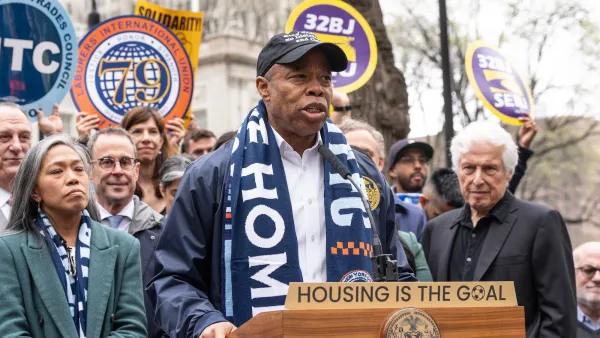
What Actually Got Built Under Eric Adams’ ‘Pro-Housing’ Administration
The outgoing mayor claims credit for hundreds of thousands of new homes. The truth is more complicated.

NYC Council Approves Brooklyn Rezoning Plan
The Atlantic Avenue Mixed Use Plan includes infrastructure investments and could bring 4,600 new housing units to parts of Brooklyn.

Planetizen Federal Action Tracker
A weekly monitor of how Trump’s orders and actions are impacting planners and planning in America.

The state-sanctioned urbicide of Austin
People don’t kill cities. Freeways do.

US to reduce Colorado River water deliveries to Mexico
A new Colorado Treaty amendment reduces Mexico’s Colorado River water allocation by 250,000 acre feet.

Baltimore to break ground on $50 million Transit Priority Project
The project will bring faster bus trips, safer streets and better bike connections to Baltimore.

Airbnb launches $250 million 'last-dollar financing' housing accelerator, makes first investment in Austin
The company will put $6.4 million towards affordable housing development in Texas’ capital.

Guerilla urbanists are building DIY bus stop benches in Chicago
A before-and-after of one of the bus stops with a new bench. The new benches are not officially sanctioned or permitted, but the residents who placed them hope they will be the start of a network of DIY benches across the city.

FREE Course: Walkable City 1: Why Walkability?
After describing his path towards focusing on walkability as the essence of good planning, Jeff Speck marches through his five principal reasons for making more walkable places.
Reinventing Malls: Planning Alchemy—Turning Gray Fields Into Gold
The course focuses on the opportunities and imperatives that shape reinvention of mall sites.

Eagle County Government
Harvard University Graduate School of Design
Nashville Planning Department
The Architects Foundation
University of Cincinnati Online
The Pocatello Development Authority
The Urban Renewal Agency of the City of Pocatello
Journal of the American Planning Association