The agency's recommendations are based on a new method of cost-benefit analysis that includes equity and environmental sustainability as key measures.


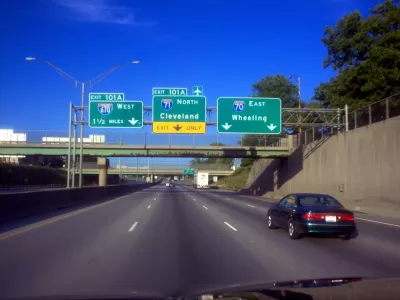
The Northeast Ohio Areawide Coordinating Agency (NOACA) is preparing to reject three proposals "to build new or enhanced highway interchanges" in the region, reports Steven Litt for Cleveland.com. The agency's recommendations "include turning down new full interchanges proposed at I-71 and Route 57 in Medina, I-71, and Boston Road in Strongsville, and I-271 and White Road in Northeast Cuyahoga County."
"The interchange recommendations are the first to be based on a detailed new method of cost-benefit analysis approved by the agency’s board in December." In addition to "traditional measures such as the local cost of traffic congestion, safety, and air pollution," the new method "also looks for the first time at issues such as racial and economic equity and environmental sustainability across the entire region."
"Among other things, the agency wants to create a clearer public understanding of how new interchanges could add to a decades-old, zero-sum pattern in which new points of access to interstate highways can spur local development that moves jobs, tax base, and investment from older communities to newer ones."
"For far too long, policies have favored sprawl and increased vehicle miles traveled. The legacy of past policies have had negative implications for our environment and have negatively impacted vulnerable communities," Cleveland Mayor Frank Jackson's office said in a statement. "we must ensure our infrastructure investments support diversity in transportation options, [and] do not contribute to sprawl, and that we are reversing the implications of climate change."
FULL STORY: NOACA ready to say ‘no’ to three new suburban highway interchanges based on detailed cost-benefit analysis


Planetizen Federal Action Tracker
A weekly monitor of how Trump’s orders and actions are impacting planners and planning in America.

The state-sanctioned urbicide of Austin
People don’t kill cities. Freeways do.

US to reduce Colorado River water deliveries to Mexico
A new Colorado Treaty amendment reduces Mexico’s Colorado River water allocation by 250,000 acre feet.

5 New England states march closer to 800 megawatt wind energy project
Securing federal approval for the project may be complicated under the Trump administration, which has historically been hostile towards domestic wind power.

Baltimore to break ground on $50 million Transit Priority Project
The project will bring faster bus trips, safer streets and better bike connections to Baltimore.

Airbnb launches $250 million 'last-dollar financing' housing accelerator, makes first investment in Austin
The company will put $6.4 million towards affordable housing development in Texas’ capital.

FREE Course: Walkable City 1: Why Walkability?
After describing his path towards focusing on walkability as the essence of good planning, Jeff Speck marches through his five principal reasons for making more walkable places.
Reinventing Malls: Planning Alchemy—Turning Gray Fields Into Gold
The course focuses on the opportunities and imperatives that shape reinvention of mall sites.


Eagle County Government
Harvard University Graduate School of Design
Nashville Planning Department
The Architects Foundation
University of Cincinnati Online
The Pocatello Development Authority
The Urban Renewal Agency of the City of Pocatello
Journal of the American Planning Association