If completed, the North Atlantic Rail project could transform New England's transportation landscape.


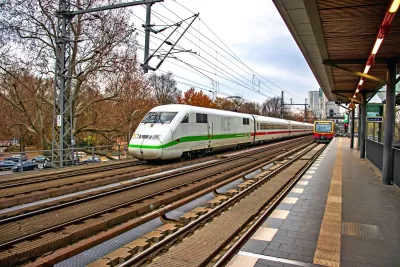
A proposed high-speed rail megaproject would connect New York and Boston via Hartford and Providence, promising a faster commute for the region's millions of workers. Anthony Flint reports on the project for Bloomberg CityLab.
The private backers of the North Atlantic Rail Project hope to attract President "Amtrak Joe" Biden's attention and federal investment, claiming that their project "checks all the boxes for a multi-benefit recovery strategy." NAR promises to cut travel time between New York and Boston down to 100 minutes, two hours shorter than Amtrak's current service. The project's supporters say it would benefit not only residents of Boston and New York but also those in the "left-behind, post-industrial legacy cities" between the two, which could see an influx of new investment and development if they become accessible by high-speed rail.
In the final phase, the NAR network would add more stops in smaller cities, making it easier for people to travel throughout the region and potentially easing housing affordability issues. Hartford mayor Luke Bronin, co-chair of the North Atlantic Rail initiative, said the new connections "would unlock economic opportunity and spur growth for dozens of mid-sized cities throughout New England, connecting the entire region in one integrated market for ideas, labor and innovation."
One major hiccup could be the project's $105-billion price tag, with the massive cost due in part to the engineering challenges faced in building and tunneling in densely developed areas and underwater. When compared to other projects around the world, however, NAR would be a small step in bringing the United States closer to having a world-class transportation system.
Read the full story: Is This High-Speed Train the First Megaproject of the Biden Era?

Proposed NYC-to-Boston HSR Would Cut Trip to Under Two Hours
The proposed project would use a mix of new and old rail lines and bypass some cities to speed up the trip.

The World’s 10 Fastest Trains
From Japan to Morocco to China, these passenger trains travel at speeds of up to 311 miles per hour.
Brightline Founder Predicts a Passenger Rail Resurgence
The HSR operator wants to expand to more US regions.

Planetizen Federal Action Tracker
A weekly monitor of how Trump’s orders and actions are impacting planners and planning in America.

The state-sanctioned urbicide of Austin
People don’t kill cities. Freeways do.

Colorado’s Largest Data Center Could Rise Next to Homes — Without a Public Hearing
The proposed campus would consume 11 times the power of Denver International Airport; as it has across the country, opposition mounts.

Judges permit Denver to divert 77,000 acre feet from the Colorado River for reservoir expansion
Overuse and climate change have caused the Colorado River’s water levels to plummet.
Amtrak, CN end decades-long dispute with eight-year agreement
The new operating agreement establishes an updated framework for the companies to work together, including processes to resolve disputes.

Raised interest rates may kill financially vulnerable construction projects
The chief economist at ConstructConnect warns that if construction project owners are negatively impacted by the raised rates, it could result in delayed payments to contractors.

FREE Course: Walkable City 1: Why Walkability?
After describing his path towards focusing on walkability as the essence of good planning, Jeff Speck marches through his five principal reasons for making more walkable places.
Reinventing Malls: Planning Alchemy—Turning Gray Fields Into Gold
The course focuses on the opportunities and imperatives that shape reinvention of mall sites.

KFH Group Inc.
Greater Baltimore Committee
Eagle County Government
The Architects Foundation
University of Cincinnati Online
The Pocatello Development Authority
The Urban Renewal Agency of the City of Pocatello