Vocal opposition hasn't slowed the Maryland Department of Transportation's progress of the I-495/I-270 Managed Lanes Project.


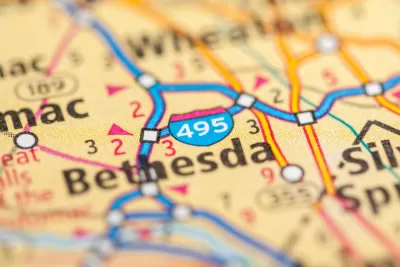
"Maryland transportation officials are moving forward with plans for its Beltway widening project by issuing a request for proposals to four developers," reports Briana Adhikusuma.
The planned expansion of I-495 and I-270 would add managed lanes through a public -private partnership at a price between $9 billion to $11 billion. According to Adhikusuma, the project "has been met with opposition in the last year from county officials, environmental activists, the U.S. Navy and county residents," in recent months. (Planetizen noted skepticism and opposition for the project in September and October this year.) The project's Draft Environmental Impact Statement, published in July 2020 and closed for public comment the following November, includes six alternatives for the Beltway widening, according to Adhikusuma, "most of which recommend adding two lanes on either side of I-495 and I-270 to accommodate high-occupancy vehicles and those opting to pay tolls."
"Financial proposals are due on Jan. 8. A Phase 1 developer is expected to be selected by Feb. 1."
Read the full story: Maryland issues request for proposals on Beltway widening

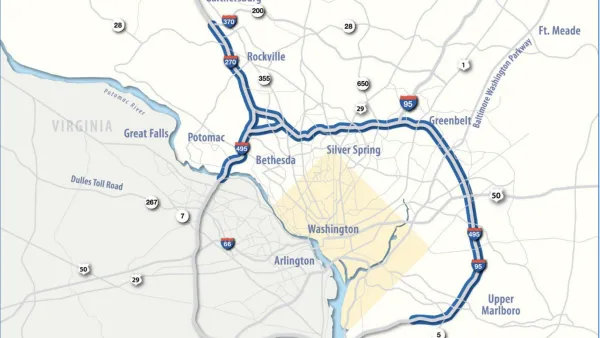
Maryland's Controversial Highway Widening Proposal Scaled Back
Interstate 270, the Capital Beltway, will no longer by widened as part of the I-495/I-270 Managed Lanes Project.
Draft Environmental Impact Statement for Maryland's Big Highway Widening Project Released
The state of Maryland is moving forward with a highway widening plan that would spend $11 billion in a private-partnership to add toll lanes to two Capital Beltway highways.
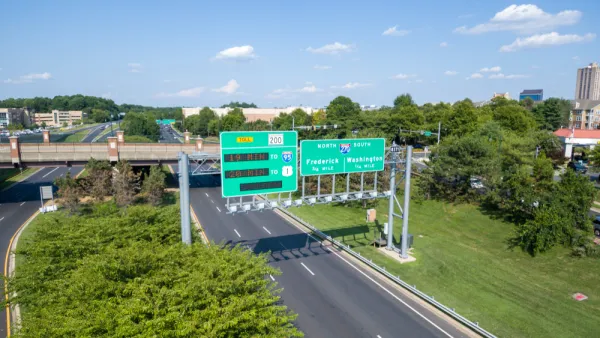
Critics: Press Pause on Highway Widening in Maryland Until COVID Impacts Are Clear
Transportation plans justified with pre-coronavirus data are now obsolete, according to a line of argument recently presented to the Maryland Transportation Authority.

Planetizen Federal Action Tracker
A weekly monitor of how Trump’s orders and actions are impacting planners and planning in America.

California plans to bury El Niño’s downpour
If the state plays its cards right, it may be able to store a billion acre-feet of El Niño’s water in aquifers.

Chicago breaks ground on $3 billion megadevelopment
The new neighborhood, titled Foundry Park, will one day host 3,700 residences.

California High-Speed Rail Authority CEO resigns after $600,000 scandal
Under Ian Choudri, the authority used taxpayer dollars to fund first class flights and trips to nightclubs.

Want to study the Missouri River? Soon, you may need unanimous approval from 10 states
Legislation would require 10 governors’ permission to study or build projects moving water outside the basin.

Desperate measures: Advocates weigh draining Lake Powell to fill Colorado River
Draining the reservoir could reduce evaporation losses by a couple hundred thousand acre-feet.

FREE Course: Walkable City 1: Why Walkability?
After describing his path towards focusing on walkability as the essence of good planning, Jeff Speck marches through his five principal reasons for making more walkable places.
Reinventing Malls: Planning Alchemy—Turning Gray Fields Into Gold
The course focuses on the opportunities and imperatives that shape reinvention of mall sites.

City of Rosemead
Rutgers University, Edward J. Bloustein School of Planning and Public Policy
One Hundred Miles
Hunter College, City University of New York (CUNY)
The Architects Foundation
University of Cincinnati Online
City of Cambridge
Montrose County
The Pocatello Development Authority