Vehicle miles traveled (VMT) and gasoline production trends point to VMT in the United States staying ten to 12 percent lower than in 2019 for the next few months, at least.


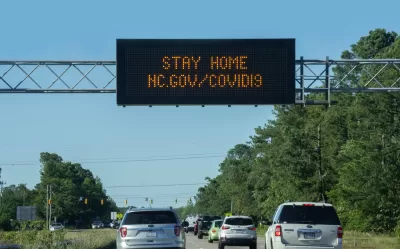
Jeff Davis reports: "The July issue of Traffic Volume Trends from the Federal Highway Administration says that total vehicle miles-traveled (VMT) on U.S. roadways in July 2020 was down 11.2 percent from the July 2019 level (262.4 billion VMT versus 295.6 billion VMT)."
To summarize this news in context of the VMT trends since the onset of the stay-at-home orders and social distancing of the pandemic, the recovery of driving in the United States is slowing, and it's likely to stay below the pace set by drivers in 2019 for the foreseeable future.
For reason to believe that VMT won’t continue to climb back to pre-pandemic levels until something changes with the novel coronavirus, Davis points at gasoline production, which has tracked throughout the pandemic as a two-week predictor of VMT, and is released more frequently and closer to real time than VMT figures.
Gas production plummeted in the second half of March, bottoming out at 42.5 percent below 2019 levels the week ending April 3. It crept back up steadily, hitting the -30 percent mark the week ending May 15, and the -20 percent mark the week ending June 5. Since then, however, gasoline production has stabilized in a narrow band that averages 10.6 percent below 2019 production levels, since the week ending June 19:
If gasoline production as a preceding indicator of VMT holds up, then aggregate VMT may also stabilize in the 10-12 percent below 2019 level for several more months.
The article also includes a regional breakdown of the VMT trends.
FULL STORY: VMT Stabilized in July; Gas Production Indicates This May Be “New Normal” Level

Where the Pandemic Has Scrambled Traffic Patterns
The map of metropolitan areas that drive least, and thus emit fewer greenhouse gas emissions, has been completely redrawn by the pandemic, according to a recent report.
Report: Vehicle Miles Traveled Almost Fully Returned to Pre-Pandemic Levels
Reports last week that the U.S. economy is about 30 percent smaller than before the pandemic aren't reflected in driving trends.
Greenhouse Gas Emissions Reduced 17% Worldwide in April, Study Says
A recently published study predicts a 4 to 7 percent decline in greenhouse gas emissions for 2020 compared to 2019.

Planetizen Federal Action Tracker
A weekly monitor of how Trump’s orders and actions are impacting planners and planning in America.

The state-sanctioned urbicide of Austin
People don’t kill cities. Freeways do.

US to reduce Colorado River water deliveries to Mexico
A new Colorado Treaty amendment reduces Mexico’s Colorado River water allocation by 250,000 acre feet.

5 New England states march closer to 800 megawatt wind energy project
Securing federal approval for the project may be complicated under the Trump administration, which has historically been hostile towards domestic wind power.

Baltimore to break ground on $50 million Transit Priority Project
The project will bring faster bus trips, safer streets and better bike connections to Baltimore.

Airbnb launches $250 million 'last-dollar financing' housing accelerator, makes first investment in Austin
The company will put $6.4 million towards affordable housing development in Texas’ capital.

FREE Course: Walkable City 1: Why Walkability?
After describing his path towards focusing on walkability as the essence of good planning, Jeff Speck marches through his five principal reasons for making more walkable places.
Reinventing Malls: Planning Alchemy—Turning Gray Fields Into Gold
The course focuses on the opportunities and imperatives that shape reinvention of mall sites.

Eagle County Government
Harvard University Graduate School of Design
Nashville Planning Department
The Architects Foundation
University of Cincinnati Online
The Pocatello Development Authority
The Urban Renewal Agency of the City of Pocatello
Journal of the American Planning Association