Former Houston METRO Board Member Christof Spieler highlights the racism embedded even in the way transit agencies were created.


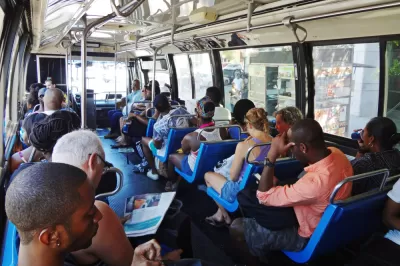
"I’ve been a transit board member, leading a transit network redesign at Houston METRO. As a planning consultant, I’ve worked with agencies in Boston and Fort Worth. I wrote a book about transit in the United States. I strongly believe that better transit can make better cities.
"But, through these experiences, I’ve seen how racism is embedded in nearly every planning discussion in America — often hiding beneath the surface. I’ve seen that transit often enables and supports racist systems. That won’t come as news to the many Americans who have lived with this reality every day since childhood. I’m not an expert on equity or a historian of race, and I know my own experience as a white man is very different from most of the people who ride transit in Houston. I definitely can’t say I’ve always gotten it right. But this is something we all have to think about and call out.
"We in the transit world, all of us who are involved in decisions about what kind of transit service to provide, and where and how to provide it, are the stewards of systems that have racism deeply rooted in them. And, unless we step back and question ourselves, are willing to have uncomfortable conversations, and share our power, we will continue to perpetuate that racism."
FULL STORY: Racism has shaped public transit, and it’s riddled with inequities

Which Houston Metro Board Members Actually Use Transit?
A review of board members' Q Cards reveals the extent to which the people who implement Houston's transit policy actually use the system: some quite a bit, some not so much.
Report Details Racial Inequality in Four Cities
Five decades after the Fair Housing Act, racial inequality is still rampant in American cities. Trulia and the National Fair Housing Alliance collaborated on this report on four of them.
Houston Needs More Public Transit Funding, Report Finds
While ridership dropped during the pandemic, many 'essential workers' continued to rely on Houston Metro's services, signaling the crucial role of public transit for the city's economy.

Planetizen Federal Action Tracker
A weekly monitor of how Trump’s orders and actions are impacting planners and planning in America.

The state-sanctioned urbicide of Austin
People don’t kill cities. Freeways do.

US to reduce Colorado River water deliveries to Mexico
A new Colorado Treaty amendment reduces Mexico’s Colorado River water allocation by 250,000 acre feet.

5 New England states march closer to 800 megawatt wind energy project
Securing federal approval for the project may be complicated under the Trump administration, which has historically been hostile towards domestic wind power.

Baltimore to break ground on $50 million Transit Priority Project
The project will bring faster bus trips, safer streets and better bike connections to Baltimore.

Airbnb launches $250 million 'last-dollar financing' housing accelerator, makes first investment in Austin
The company will put $6.4 million towards affordable housing development in Texas’ capital.

FREE Course: Walkable City 1: Why Walkability?
After describing his path towards focusing on walkability as the essence of good planning, Jeff Speck marches through his five principal reasons for making more walkable places.
Reinventing Malls: Planning Alchemy—Turning Gray Fields Into Gold
The course focuses on the opportunities and imperatives that shape reinvention of mall sites.

Eagle County Government
Harvard University Graduate School of Design
Nashville Planning Department
The Architects Foundation
University of Cincinnati Online
The Pocatello Development Authority
The Urban Renewal Agency of the City of Pocatello
Journal of the American Planning Association