The saga of the three-county sales tax upon which the future of Caltrain depends is now in the hands of voters.


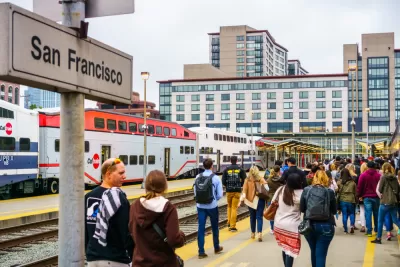
"San Francisco's Board of Supervisors unanimously approved an eighth-cent sales tax measure for the November to fund Caltrain during a special meeting Friday -- the last day to place the measure on the county ballots," reports Daniel Montes.
The decision culminates weeks of political back and forth as political leaders from San Francisco, Santa Clara, and San Mateo counties held the sales tax measure as leverage in a battle over governance of the commuter rail system.
San Francisco and Santa Clara officials in July approved a version of the sales tax that San Mateo officials called dead on arrival. This latest version of the sales tax measure, with governance issues stripped from the measure that will appear before voters in November, came in just under the wire, and could save the beleaguered rail system. Earlier in July, the San Francisco County Supervisors rejected a version of the ballot measure approved by San Mateo county officials.
"If ultimately approved by two thirds of voters across San Francisco, San Mateo and Santa Clara counties, the tax would generate an estimated $108 million annually. The funding is desperately needed to operate the system as ridership has plummeted during the COVID-19 pandemic," according to Montes.
More than providing a lifeline during the diminished ridership of the pandemic, the sales tax measure is also intended to fund a major expansion of service on Caltrain, designed to be commensurate with existing service on the other regional transit system serving the San Francisco Bay Area—BART.
Read the full story: Caltrain sales tax to be placed on November ballot after SF Supervisors pass measure
Plan to Save Caltrain Emerges
Elected officials in San Francisco and Santa Clara counties have produced a counter proposal after killing a proposed sales tax last week.
Caltrain on the Rocks as Sales Tax Measure Fails
Advocates are concerned about the possibility of Caltrain entirely shutting down—less than a year after the commuter rail line seemed positioned for a massive expansion of service.
One Rail System to Ring the Bay Area? Supporters See Reasons for Optimism
A plan to integrate the various regional transit providers in the San Francisco Bay Area could be the key to winning back transit riders in the post-pandemic world.

Planetizen Federal Action Tracker
A weekly monitor of how Trump’s orders and actions are impacting planners and planning in America.

Eastern Nebraska is running out of electricity
Data centers and electrification are straining eastern Nebraska’s grid, throttling economic development.

Study reveals best places in the U.S. for cycling, walking
New research from Streetlight Data examines bicycle and pedestrian miles per capita in the 100 largest U.S. cities by population.

DSA members accuse Mamdani of 'abandoning values' over housing redevelopment
New York City's mayor plans to replace about 2,000 units of public housing with private, mixed-income housing.

All sides of BRT debate unhappy with CDOT’s most recent move
The Colorado Department of Transportation is no longer considering center-running bus lanes for Colorado Boulevard.

Massachusetts bogs generate both power, and cranberries
Putting solar panels above farmland is one way Massachusetts is advancing toward its goal of net-zero carbon emissions by 2050.

FREE Course: Walkable City 1: Why Walkability?
After describing his path towards focusing on walkability as the essence of good planning, Jeff Speck marches through his five principal reasons for making more walkable places.
Reinventing Malls: Planning Alchemy—Turning Gray Fields Into Gold
The course focuses on the opportunities and imperatives that shape reinvention of mall sites.

City of Rosemead
Rutgers University, Edward J. Bloustein School of Planning and Public Policy
One Hundred Miles
University of Michigan School for Environment and Sustainability (SEAS)
Hunter College, City University of New York (CUNY)
The Architects Foundation
City of Cambridge
The Pocatello Development Authority
The Urban Renewal Agency of the City of Pocatello