Elected officials in San Francisco and Santa Clara counties have produced a counter proposal after killing a proposed sales tax last week.


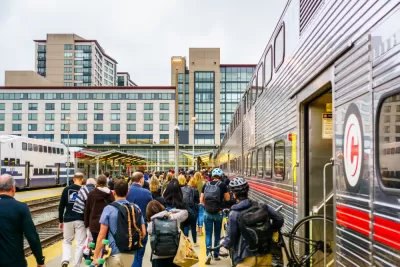
"A new proposal to save the 160-year-old Caltrain rail line was released by elected officials in San Francisco and Santa Clara County on Tuesday as supervisors there attempt to use the potential death of the transit agency as leverage in a power struggle with San Mateo County," reports Aldo Toledo.
According to Toledo, "the Caltrain governing board could be significantly changed under a new proposal signed by Mayors Sam Liccardo and London Breed, as well some members of both boards of supervisors." Changes in governance were key to a controversial vote by San Francisco Supervisors last week to kill a proposed sales tax to fund an expansion of service on the commuter rail system. Now the sales tax measure is being touted as a funding measure to help Caltrain weather the fiscal crisis created by the pandemic.
The article includes more details about the governance structure of Caltrain, and how the new proposal would change the equation.
Between the vote and the new proposal, San Francisco County Supervisor Aaron Peskin created a stir on social media by claiming that San Mateo County officials are exaggerating the existential threat to Caltrain.
I know the San Mateo PR machine would like advocates to think that Caltrain is all but dead but it’s literally just factually untrue.
We’ll continue to pay our fair share to supporting its essential functions, though our top priority has to be Muni.— Aaron Peskin (@AaronPeskin) July 16, 2020
>
Read the full story: New Caltrain lifeline proposal could include changes to the agency’s governing structure

Compromise Reached to Save Caltrain
The saga of the three-county sales tax upon which the future of Caltrain depends is now in the hands of voters.
Caltrain on the Rocks as Sales Tax Measure Fails
Advocates are concerned about the possibility of Caltrain entirely shutting down—less than a year after the commuter rail line seemed positioned for a massive expansion of service.
One Rail System to Ring the Bay Area? Supporters See Reasons for Optimism
A plan to integrate the various regional transit providers in the San Francisco Bay Area could be the key to winning back transit riders in the post-pandemic world.

Planetizen Federal Action Tracker
A weekly monitor of how Trump’s orders and actions are impacting planners and planning in America.

Amtrak, CN end decades-long dispute with eight-year agreement
The new operating agreement establishes an updated framework for the companies to work together, including processes to resolve disputes.

Judges permit Denver to divert 77,000 acre feet from the Colorado River for reservoir expansion
Overuse and climate change have caused the Colorado River’s water levels to plummet.

How ‘post-disaster gentrification’ alters neighborhoods after natural calamities
After hurricanes, fires or other calamities, the original residents of a community are often replaced by younger, wealthier residents.

Maryland local governments examine if they should have more power to raise property taxes
Maryland’s housing market is out of reach for the majority of moderate-income residents.

Northwest rail fans eager for Sept. 30 debut of Amtrak’s Airo fleet
Get ready for that new train smell and more seats. But they won’t go faster or run more frequently on the Cascades route in Washington and Oregon.

FREE Course: Walkable City 1: Why Walkability?
After describing his path towards focusing on walkability as the essence of good planning, Jeff Speck marches through his five principal reasons for making more walkable places.
Reinventing Malls: Planning Alchemy—Turning Gray Fields Into Gold
The course focuses on the opportunities and imperatives that shape reinvention of mall sites.

Harvard University Graduate School of Design
KFH Group Inc.
Greater Baltimore Committee
The Architects Foundation
University of Cincinnati Online
The Pocatello Development Authority
The Urban Renewal Agency of the City of Pocatello