The Seattle Planning Commission recently published a report titled "A Racially Equitable and Resilient Recovery."


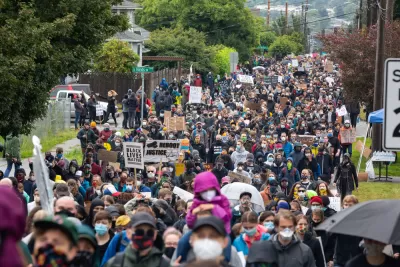
The economic recovery from the Great Recession exacerbated inequality, according to an article by Natalie Bicknell. "Now as people look anxiously forward to a recovery from the current Covid crisis, government leaders, policy makers, and advocates are beginning to strategize over how to increase racial equity and build community resiliency during the recovery."
The Seattle Planning Commission (SPC), a 16-member volunteer body appointed by the Seattle's mayor and City Council, recently published "A Racially Equitable and Resilient Recovery" to ensure that planning processes will partner with historically marginalized and at-risk communities as the city digs itself out of the pandemic's economic hole.
The report recommend five key strategies, as listed here but with more detail provided in the source article:
- Working in collaboration with BIPOC communities to create a planning process that shares power with communities
- Advancing housing choices and security in response to COVID-19 while expanding homeownership opportunities for BIPOC communities
- Maintaining the critical transit network and ensure City rights-of-way meets safety and open-space needs for BIPOC communities
- Ensuring public spaces work for everyone by centering and implementing BIPOC visions for the public realm
- Investing equitably in healthy and climate-resilient communities
To supplement this information about the Seattle Planning Commission's plans for assisting in an equitable economic recovery from the pandemic, Seattle Planning Director Sam Assefa recently sat down for an interview with Amy Dillemith for the American Planning Association. In the interview, Assefa explains the way the Seattle Department of Planning and Development is assisting in short- and long-term recovery events. For the long-term, Assefa points specifically to issues of budget, executive orders from the mayor, and self-started activities from within the department.
FULL STORY: Seattle Planning Commission Maps Out Equitable Covid Recovery Strategies

Opinion: Lower Rents Will Give Downtown Spaces Back to the ‘Weirdos’
Introducing the “CBGB theory of city planning.”

Seattle Ponders a New Approach to Zoning for its Comprehensive Plan Update
The city of Seattle will have an updated comprehensive plan by the end of 2024, with zoning changes to follow by 2025.

New Community Engagement Practices for Seattle’s Comprehensive Plan Update
A major update of Seattle’s comprehensive plan is just getting under way, with new opportunities for local groups to get involved with outreach and engagement.

Planetizen Federal Action Tracker
A weekly monitor of how Trump’s orders and actions are impacting planners and planning in America.

The state-sanctioned urbicide of Austin
People don’t kill cities. Freeways do.

US to reduce Colorado River water deliveries to Mexico
A new Colorado Treaty amendment reduces Mexico’s Colorado River water allocation by 250,000 acre feet.

5 New England states march closer to 800 megawatt wind energy project
Securing federal approval for the project may be complicated under the Trump administration, which has historically been hostile towards domestic wind power.

Baltimore to break ground on $50 million Transit Priority Project
The project will bring faster bus trips, safer streets and better bike connections to Baltimore.

Airbnb launches $250 million 'last-dollar financing' housing accelerator, makes first investment in Austin
The company will put $6.4 million towards affordable housing development in Texas’ capital.

FREE Course: Walkable City 1: Why Walkability?
After describing his path towards focusing on walkability as the essence of good planning, Jeff Speck marches through his five principal reasons for making more walkable places.
Reinventing Malls: Planning Alchemy—Turning Gray Fields Into Gold
The course focuses on the opportunities and imperatives that shape reinvention of mall sites.

Eagle County Government
Harvard University Graduate School of Design
Nashville Planning Department
The Architects Foundation
University of Cincinnati Online
The Pocatello Development Authority
The Urban Renewal Agency of the City of Pocatello
Journal of the American Planning Association