Coronavirus cases are surging throughout the South and West. With growing hospitalizations threatening the capacity of the health care systems in major cities in Texas, Gov. Gregg Abbott pressed 'pause' on the state's reopening plan.


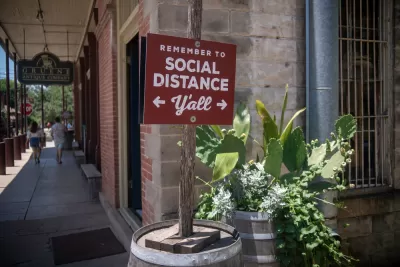
"Gov. Greg Abbott (R) announced Thursday that Texas would delay moving into its next phase of reopening as it struggles to contain a surge in coronavirus infections and hospitalizations," reports Kim Bellware for The Washington Post.
“The last thing we want to do as a state is go backwards and close down businesses,” Abbott said in a statement Thursday. “This temporary pause will help our state corral the spread until we can safely enter the next phase of opening our state for business.”
The rolling average of daily new cases in Texas has increased 62 percent from the last week, jumping from 2,610 on June 18 to 4,227 as of Thursday, according to data tracked by The Washington Post.
As cases grow, hospitals begin to fill up.
"Statewide, the number of hospitalizations has reached record highs for two weeks, soaring to 4,739 on Thursday morning and tripling since Memorial Day," reports Sarah R. Champagne for The Texas Tribune. "On Wednesday, the state had 1,320 available intensive care unit [ICU] beds and nearly 13,000 available hospital beds, but with regional disparities."
In hard-hit areas, some hospitals have begun moving coronavirus patients from crowded ICUs to other facilities, and local leaders have warned that hospitals could get overwhelmed if the number of infections keeps climbing. In the greater Houston area, the Texas Medical Center said Thursday that its intensive care units have reached 100% of base capacity.
Apocalyptic?
Dr. Peter Hotez, dean of the Houston-based National School of Tropical Medicine at the Baylor College of Medicine, warned that "Houston could be the hardest-hit city in the US with numbers rivaling those in Brazil," reports Jay Croft for CNN on June 25.
"The big metro areas seem to be rising very quickly and some of the models are on the verge of being apocalyptic," Hotez told CNN's Anderson Cooper...
"We're not seeing the deaths yet, but that will start," Hotez said. "Those deaths will start to mount up, I would say, in a couple of weeks."
According to Covid Act Now, a website designed to help elected officials determine the scope of the pandemic in their regions, "Texas is at risk of an outbreak." The warning: "COVID cases are either increasing at a rate likely to overwhelm hospitals and/or the state’s COVID preparedness is well below international standards."
It makes that assessment based on four pubic health indicators. Ironically, the only one it passes is ICU capacity: "Can likely handle a new wave of COVID."
Will pause be enough?
"Former Food and Drug Administration commissioner Scott Gottlieb warned Thursday that states such as Texas that have spiking infection rates would have to quickly implement policy changes to contain the outbreak in the weeks ahead," adds Bellware for the Post. Speaking on MSNBC, he also cautioned that the outcome of the next week or two is “already baked” in in hot spots.
Former Food and Drug Administration commissioner Scott Gottlieb warned Thursday that states such as Texas that have spiking infection rates would have to quickly implement policy changes to contain the outbreak in the weeks ahead. Gottlieb, speaking on MSNBC, also cautioned that the outcome of the next week or two is “already baked” in in hot spots.
Gottlieb didn't appear keen on shutting down businesses, largely because he believes there is no political will to do so, but he did offer a suggestion to governors that are seeing large increases in hospitalizations:
"I think they need to figure out where the spread is occuring; what the congregate settings are where the spread is actually occuring at the highest rate, and target interventions toward those venues. So if it's spreading in bars, they might have to shut down bars..."
That's exactly what the health district that overseas Boise, Idaho, did on Wednesday: they shut down bars and nightclubs in all of the state's most populous county.
Correspondent's note: The source article was posted at 10:12 am and may not appear among the "live updates" for June 25 titled, "U.S. sets another single-day record for coronavirus cases."
Related in Planetizen:
-
More than a Pause: Reversing the Reopening, June 24, 2020
-
[Oregon and Utah Press Pause on Reopening], June 15, 2020
FULL STORY: Texas pauses reopening amid surge in coronavirus cases and hospitalizations


Bars or Schools? Governors Need to Decide
In a frank assessment of the reopening choices confronting the nation's governors, Harvard's global health expert, Ashish Jha, asserts that the opening of bars and some other indoor businesses jeopardizes the opening of schools in the fall.
COVID's New Demographic
Younger people are making up more of the new cases of COVID-19 as the coronavirus explodes in the Sunbelt states, particularly Arizona, California, Florida, and Texas, bringing with it new attention on bars as settings for high viral transmission.
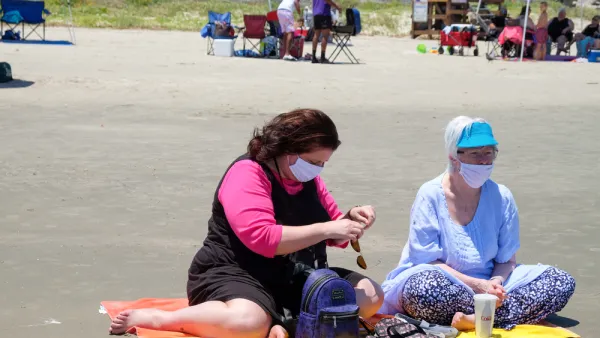
City vs. State: Mayors Want Power to Require Mask Wearing to Slow Coronavirus Spread
Coronavirus cases are surging in the Lone Star State's urban areas, so mayors of nine of its largest cities asked Greg Abbott for the power to mandate the wearing of masks or facial coverings, prohibited by executive order, to slow viral spread.

The state-sanctioned urbicide of Austin
People don’t kill cities. Freeways do.

US to reduce Colorado River water deliveries to Mexico
A new Colorado Treaty amendment reduces Mexico’s Colorado River water allocation by 250,000 acre feet.

New Jersey’s second-largest city bans standalone data centers
Jersey City will continue to allow co-location facilities, such as those meant for research institutions that store their own data.

Amtrak not solely to blame for New Jersey commuter rail's unreliability, report finds
A new study from the Garden State Initiative found that NJ Transit’s budget grew 20% across a 4 year period, but reliability declined significantly over the same period.

EPA erases limits on planet-warming pollution from power plants
Under Monday’s plan, power plants would still have some limits on how much mercury, arsenic and other contaminants they can emit.

Phoenix announces new on-demand transit service, more frequent RAPID buses
Both new services will launch in October, and are part of Phoenix's Project Effective Access Solutions for Easing Congestion.

FREE Course: Walkable City 1: Why Walkability?
After describing his path towards focusing on walkability as the essence of good planning, Jeff Speck marches through his five principal reasons for making more walkable places.
Reinventing Malls: Planning Alchemy—Turning Gray Fields Into Gold
The course focuses on the opportunities and imperatives that shape reinvention of mall sites.

Eagle County Government
Harvard University Graduate School of Design
Nashville Planning Department
The Architects Foundation
University of Cincinnati Online
The Pocatello Development Authority
The Urban Renewal Agency of the City of Pocatello
Journal of the American Planning Association