Los Angeles has a parking problem—namely, too much of it—caused by minimum parking requirements.


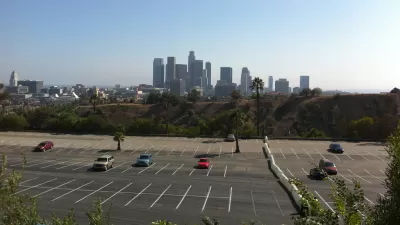
Los Angeles has 6 million parking spaces, many more than the city needs, and the minimum mandatory parking policy is a source of the problem, writes Anthony Dedousis.
When buildings are required to provide a certain amount of parking, the result is an overflow of parking that encourages driving and takes up valuable space that could be used for additional housing and pedestrian and biking infrastructure.
The Department of City Planning is considering eliminating parking minimums in downtown Los Angeles. But Dedousis thinks a bolder step needs to be taken.
"Instead of simply removing parking minimums, L.A. should introduce parking maximums downtown. New buildings would still be allowed to construct on-site parking, but only up to a limit. Developments requiring more parking than the maximum could lease it from existing buildings and garages with surpluses," he says.
In addition, officials should extend such a policy beyond downtown to the rest of the city. "L.A. needs its leaders to take a stand. We have enough homes for cars. Let’s prioritize homes and mobility for people," argues Dedousis.
Read the full story: Op-Ed: Los Angeles is building plenty of housing ... for cars

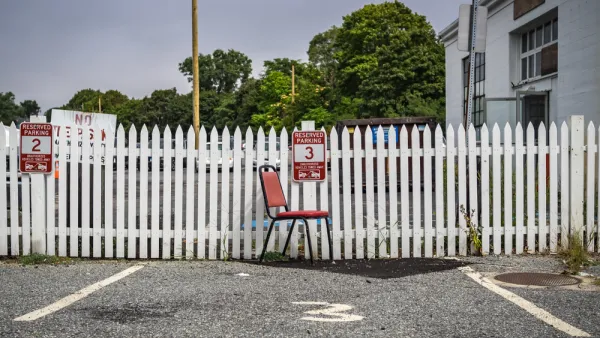
A Post-Car-as-King Planning World
Cities not named from Boston in Massachusetts are explored for lessons in contemporary parking regulations.

Residence in Chicago's TODs Come With a Major Caveat: No Parking Permits
One big idea behind transit oriented residential developments is that residents will be liberated from their cars. New developments in Chicago are making sure residents won't be parking on streets to get the best of both worlds.

Exposé: Development Obstruction in Los Angeles
Homeowners groups use their influence to extract payments and concessions in Los Angeles.

Planetizen Federal Action Tracker
A weekly monitor of how Trump’s orders and actions are impacting planners and planning in America.

The state-sanctioned urbicide of Austin
People don’t kill cities. Freeways do.

Colorado’s Largest Data Center Could Rise Next to Homes — Without a Public Hearing
The proposed campus would consume 11 times the power of Denver International Airport; as it has across the country, opposition mounts.

Nation's most wind-powered state turns to coal as data centers increase energy demand
For the first time in decades, Iowa has increased its generation of coal power.

NYC cools commuters with city's first rain garden above a bus stop
New York City officials say the plants in the rain garden can absorb 16 gallons of rainwater during heavy storms.

Brightline West’s future may rely on $6 billion federal loan
The company has until Nov. 2 to make a $400 million equity investment into its proposed high-speed rail line.

FREE Course: Walkable City 1: Why Walkability?
After describing his path towards focusing on walkability as the essence of good planning, Jeff Speck marches through his five principal reasons for making more walkable places.
Reinventing Malls: Planning Alchemy—Turning Gray Fields Into Gold
The course focuses on the opportunities and imperatives that shape reinvention of mall sites.

Greater Baltimore Committee
Eagle County Government
Harvard University Graduate School of Design
The Architects Foundation
University of Cincinnati Online
The Pocatello Development Authority
The Urban Renewal Agency of the City of Pocatello
Journal of the American Planning Association