The United Nations announces more bad news for the climate and the role of American society and culture in causing the destruction of the planet.



Somini Sengupta reports on the latest United Nations report to sound the alarms about the effect of carbon emissions on the planet's climate: "With world leaders gathering in Madrid next week for their annual bargaining session over how to avert a climate catastrophe, the latest assessment issued by the United Nations said Tuesday that greenhouse gas emissions are still rising dangerously."
The Emissions Gap Report, by the United Nations Environment Program, describes its findings as "bleak."
"Countries have failed to halt the rise of greenhouse gas emissions despite repeated warnings from scientists, with China and the United States, the two biggest polluters, further increasing their emissions last year," explains Sengupta.
For commentary on the report, articles by Aaron Short for Streetsblog USA and Michael Anderson for the Sightline Institute provide plenty of planning related material.
Short notes that one of the key recommendations of the report for quickly and significantly reducing the amount of carbon emissions would be to reduce the size of vehicles. To achieve that goal would require reversing the current trend in automobile preference in the United States, writes Short: "Sales of SUVs and light trucks have risen sharply over the past decade, so now SUVs represent 69 percent of the automobile market share in the U.S., up from 49 percent in 2008."
Anderson focuses on land use, noting the report's recommendation to remove legal barriers to more contact development. In fact, the report suggests a 20 percent reduction to average floor area per person by 2050. The report calls out the United States in particular for making more compact living arrangement illegal in most of the country.
FULL STORY: ‘Bleak’ U.N. Report on a Planet in Peril Looms Over New Climate Talks

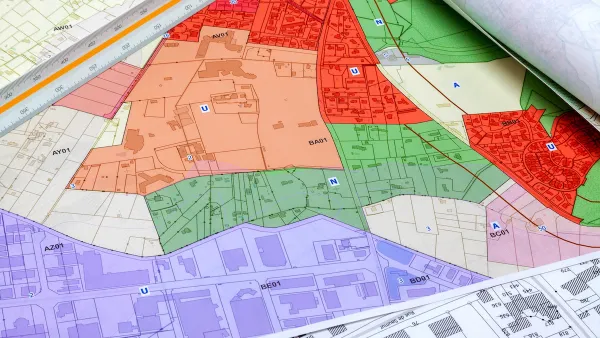
How Zoning Affects Greenhouse Gas Emissions
As the urgency of the climate crisis increases, a paper in the Notre Dame Law Review argues that increased density is not a universally effective strategy to reduce emissions and that different strategies are needed for low-carbon places versus high-carbon ones.

Former San Diego Mayor Leaves Pro-Development Politics Behind for Recall Race
While Mayor of San Diego, Republican Kevin Faulconer made a name for himself as a prominently YIMBY politician. He's abandoned those views now that he's running for Gov. Gavin Newsom's spot in the state's recall race.

Wales to Cease Road Construction Projects in Bid to Achieve Net Zero Emissions
The Welsh government is taking a bold stand for climate action.

The state-sanctioned urbicide of Austin
People don’t kill cities. Freeways do.

US to reduce Colorado River water deliveries to Mexico
A new Colorado Treaty amendment reduces Mexico’s Colorado River water allocation by 250,000 acre feet.

New Jersey’s second-largest city bans standalone data centers
Jersey City will continue to allow co-location facilities, such as those meant for research institutions that store their own data.

Amtrak not solely to blame for New Jersey commuter rail's unreliability, report finds
A new study from the Garden State Initiative found that NJ Transit’s budget grew 20% across a 4 year period, but reliability declined significantly over the same period.

EPA erases limits on planet-warming pollution from power plants
Under Monday’s plan, power plants would still have some limits on how much mercury, arsenic and other contaminants they can emit.

Phoenix announces new on-demand transit service, more frequent RAPID buses
Both new services will launch in October, and are part of Phoenix's Project Effective Access Solutions for Easing Congestion.

FREE Course: Walkable City 1: Why Walkability?
After describing his path towards focusing on walkability as the essence of good planning, Jeff Speck marches through his five principal reasons for making more walkable places.
Reinventing Malls: Planning Alchemy—Turning Gray Fields Into Gold
The course focuses on the opportunities and imperatives that shape reinvention of mall sites.

Eagle County Government
Harvard University Graduate School of Design
Nashville Planning Department
The Architects Foundation
University of Cincinnati Online
The Pocatello Development Authority
The Urban Renewal Agency of the City of Pocatello
Journal of the American Planning Association