Portland will soon be spreading out the red carpet for buses.


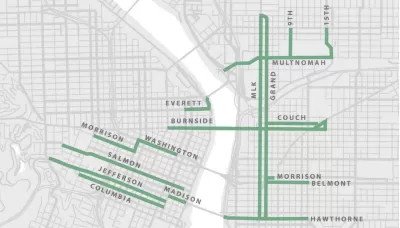
"Late last month, the Portland Bureau of Transportation received approval from the Federal Highway Administration to use red coloring on bus-only lanes," reports Jonathan Maus.
Despite their appearance in cities like Seattle and San Francisco, "the use of red to designate bus-only lanes hasn’t been fully adopted into the FHWA’s Manual on Uniform Traffic Control Devices (MUTCD)," explains Maus, necessitating a "request to experiment" before the street treatment can be installed.
Maus also cites Jarrett Walker in explaining the state of the "experiment":
Jarrett Walker, an author and consultant who helps cities improve bus service, says red bus lanes are a no-brainer. “They are an absurdly obvious idea and it’s even more absurd that the federal government had to give us permission,” he shared in an email this morning.
The Portland Bureau of Transportation will use their new red painting powers to implement the Rose Lane Project, funded with $2.5 million from the Bloomberg American Cities Climate Challenge. PDOT still has to finalize the plans for the city's forthcoming bus-only lane network.
"A list of 25 potential bus priority routes were adopted in June 2018 when council passed the Enhanced Transit Corridors (ETC) plan," according to Maus. "That plan identified 15 central city (two of which – SW Madison and NE Everett — have already been implemented) and 10 regional routes that could be turning red (see maps below). 11 of the central city routes are likely to come with a “low-stress” cycling facility."
The city expects to finalize those plans by the end of 2020.
FULL STORY: With key federal approval, Portland is ‘full steam ahead’ on bus lane project

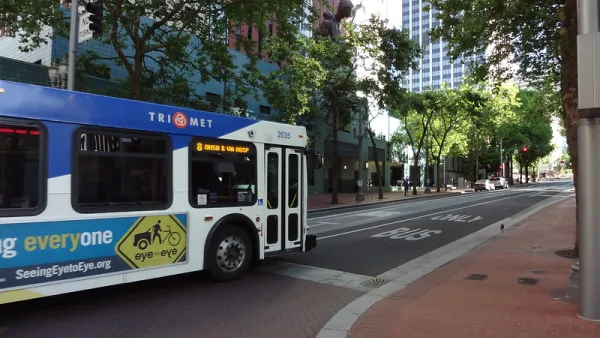
'Rose Lane Project' Proposed to Prioritize Bus Improvements in Portland
The city of Portland last week revealed a new transit planning project intended to speed up and increase bus service, and hopefully increase ridership as a result.
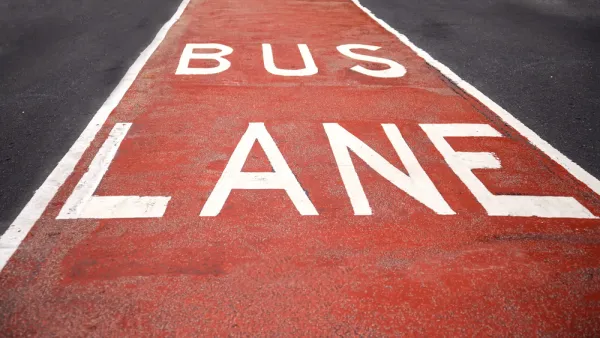
The Benefits of Bright Red Bus-Only Lanes, Explained
Richmond, Virginia is adding red paint to 2.5 miles of bus-only lanes. An article in the local newspaper explains why the change is more than an aesthetic consideration.
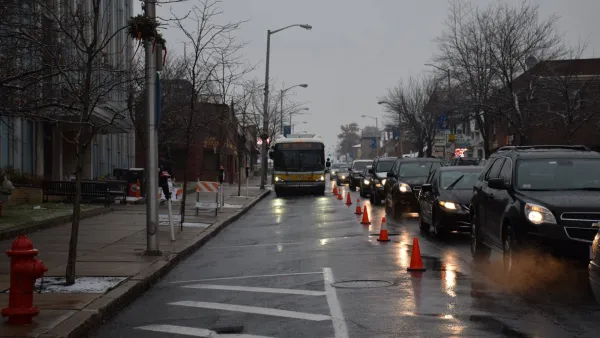
How to Improve Bus Service and Performance on Busy Corridors
A new report collects the lessons and best practices of several years of bus priority projects in the Boston region.

Planetizen Federal Action Tracker
A weekly monitor of how Trump’s orders and actions are impacting planners and planning in America.

The state-sanctioned urbicide of Austin
People don’t kill cities. Freeways do.

US to reduce Colorado River water deliveries to Mexico
A new Colorado Treaty amendment reduces Mexico’s Colorado River water allocation by 250,000 acre feet.

Mamdani overhauls NYC's Vision Zero plan with 100 new policy goals
The overhaul aims to reduce traffic deaths and make streets safer for pedestrians, cyclists and drivers through lower speed limits, new safety infrastructure and more.

Amtrak not solely to blame for New Jersey commuter rail's unreliability, report finds
A new study from the Garden State Initiative found that NJ Transit’s budget grew 20% across a 4 year period, but reliability declined significantly over the same period.

EPA erases limits on planet-warming pollution from power plants
Under Monday’s plan, power plants would still have some limits on how much mercury, arsenic and other contaminants they can emit.

FREE Course: Walkable City 1: Why Walkability?
After describing his path towards focusing on walkability as the essence of good planning, Jeff Speck marches through his five principal reasons for making more walkable places.
Reinventing Malls: Planning Alchemy—Turning Gray Fields Into Gold
The course focuses on the opportunities and imperatives that shape reinvention of mall sites.

Eagle County Government
Harvard University Graduate School of Design
Nashville Planning Department
The Architects Foundation
University of Cincinnati Online
The Pocatello Development Authority
The Urban Renewal Agency of the City of Pocatello
Journal of the American Planning Association