The city of Portland last week revealed a new transit planning project intended to speed up and increase bus service, and hopefully increase ridership as a result.


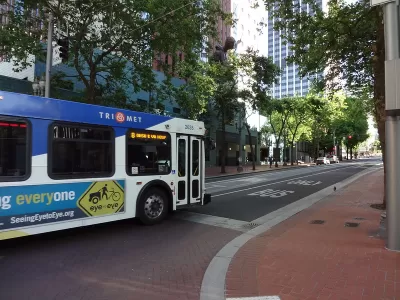
Jonathan Maus reports on the details of the newly revealed Rose Lane Project, championed by Portland Bureau of Tranportation Commissioner Chloe Eudaly.
Maus writes: "To meet goals adopted in the Climate Action Plan and Transportation System Plan, Portland needs to more than double the amount of daily commute trips made by transit by 2035. In PBOT’s words as published on the new Rose Lane Project website, 'We have work to do.'"
"The Rose Lane Project is being pitched as an 'accelerated implementation' of the PBOT’s Enhanced Transit Corridors plan which was adopted by City Council last year," adds Maus.
Maus also provides details of a recent Portland City Council meeting, at which Eudaly sought initial support for the project from the council. Much of the discussion at the meeting focused on the racial disparities present in the city's transportation network.
Read the full story: ‘Rose Lane Project’ launches with focus on racial disparities and climate action

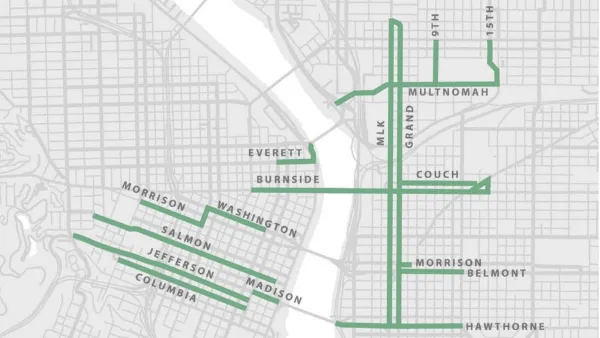
Federal Approval Clears Way for Bus-Only Lanes in Portland
Portland will soon be spreading out the red carpet for buses.

Suburban Detroit Achieves Long-Awaited Bus Service Expansion
Novi and Bloomfield Hills in Southeast Michigan will have transit service for the first time in 28 years.
The Bus Revolution Has Been Revised in Philadelphia
The Southeastern Pennsylvania Transportation Authority went back to the drawing board with its Bus Revolution system redesign after an initial round of feedback completed earlier this year.

Planetizen Federal Action Tracker
A weekly monitor of how Trump’s orders and actions are impacting planners and planning in America.

California plans to bury El Niño’s downpour
If the state plays its cards right, it may be able to store a billion acre-feet of El Niño’s water in aquifers.

Desperate measures: Advocates weigh draining Lake Powell to fill Colorado River
Draining the reservoir could reduce evaporation losses by a couple hundred thousand acre-feet.

Chicago Avenue bridge construction delays enrages city leaders
The bridge has been closed since 2025. The city originally aimed to re-open it in December, and now expects to finish construction in 2027.

NYC bus network redesign speeds up Queens buses
Rush routes have seen a 4.6% speed increase after the redesign.

California High-Speed Rail Authority picks trainset manufacturer
The California High-Speed Rail Authority aims to start servicing passengers by 2033.

FREE Course: Walkable City 1: Why Walkability?
After describing his path towards focusing on walkability as the essence of good planning, Jeff Speck marches through his five principal reasons for making more walkable places.
Reinventing Malls: Planning Alchemy—Turning Gray Fields Into Gold
The course focuses on the opportunities and imperatives that shape reinvention of mall sites.

City of Rosemead
Rutgers University, Edward J. Bloustein School of Planning and Public Policy
One Hundred Miles
Hunter College, City University of New York (CUNY)
The Architects Foundation
University of Cincinnati Online
City of Cambridge
Montrose County
The Pocatello Development Authority