Maryland approved ambitious plans for public transit expansion around Baltimore in 2002, but almost none of it became a reality. With a new plan in the works, transit boosters assess the loss of a generation's worth of progress.


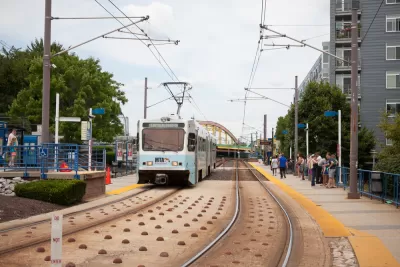
Josh Kurtz performs a post-mortem on the recent history of transit planning in the state of Maryland—almost all of which never came to fruition.
In 2002, Maryland transportation planners put the finishing touches on a proposal to dramatically expand mass transit in the state. The plan envisioned six new or improved transit lines, with 122 new transit station stops built over 40 years.
Today, only the Purple Line, a light rail project linking New Carrollton to Bethesda, survives. The Red Line, an east-west transit project in Baltimore, came close to final federal approval, but Gov. Lawrence J. Hogan Jr. (R) pulled the plug on the project in 2015.
The final nail in the coffin for those grand ambitions came in September when Maryland Governor Larry Hogan's administration announced that it would no longer prioritize the Corridor Cities Transitway, a bus rapid transit line in Montgomery County.
This post-mortem is set against the backdrop of a new transit planning study in the state, however: the Regional Transit Plan for Central Maryland. A draft plan is expected to be complete in a year, so the Greater Baltimore Committee and the Greater Washington Partnership recently held a public discussion on the future of transit in Maryland, but those in attendance couldn't avoid the past and the future.
As noted by Kurtz, several additional public forums on the Regional Transit Plan for Central Maryland are scheduled through the rest of the month.
Read the full story: On Transit, Pondering What Might Be and Lamenting What Might Have Been

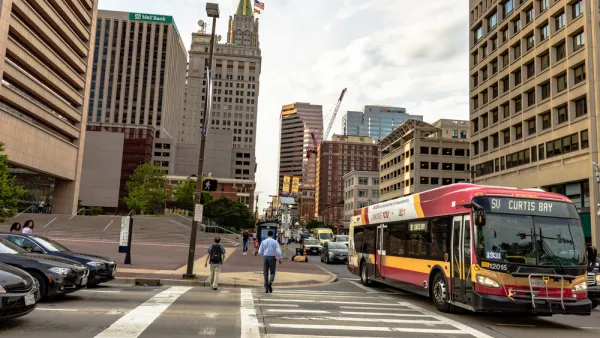
Central Maryland Regional Transit Plan: First Regional Transit Plan for Baltimore Since 2002
Transit planners in the Baltimore area are working on plans for a more reliable, useful regional transit system.
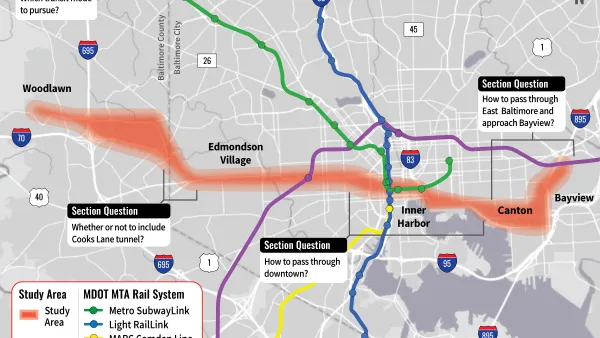
Maryland to Restart Planning for East-West Transit Line Through Baltimore
A plan for the Red Line, an east-west light rail line notoriously canceled by former-Governor Larry Hogan in 2015, is back on the table in Baltimore.
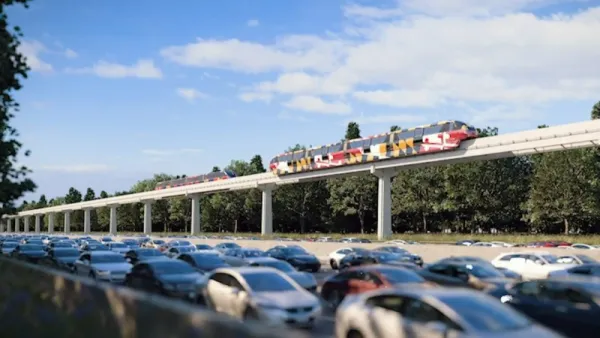
Monorail Study Moves Forward in Maryland
A plan to widen Interstate 270 in Maryland was approved earlier this year under the condition that the state also study a plan to build a monorail along the route.

Planetizen Federal Action Tracker
A weekly monitor of how Trump’s orders and actions are impacting planners and planning in America.

California plans to bury El Niño’s downpour
If the state plays its cards right, it may be able to store a billion acre-feet of El Niño’s water in aquifers.

Desperate measures: Advocates weigh draining Lake Powell to fill Colorado River
Draining the reservoir could reduce evaporation losses by a couple hundred thousand acre-feet.

California city breaks ground on transit connector
The project includes three mobility hubs and a pedestrian bridge.

After public outcry, Massachusetts city releases housing development tracker
Cambridge’s tracker currently shows 250 housing projects in various stages of development.

40 years after approval, Chicago breaks ground on new park
The park honors Jean Baptiste Point du Sable, the city’s first permanent non-native settler.

FREE Course: Walkable City 1: Why Walkability?
After describing his path towards focusing on walkability as the essence of good planning, Jeff Speck marches through his five principal reasons for making more walkable places.
Reinventing Malls: Planning Alchemy—Turning Gray Fields Into Gold
The course focuses on the opportunities and imperatives that shape reinvention of mall sites.

City of Rosemead
Rutgers University, Edward J. Bloustein School of Planning and Public Policy
One Hundred Miles
Hunter College, City University of New York (CUNY)
The Architects Foundation
University of Cincinnati Online
City of Cambridge
Montrose County
The Pocatello Development Authority