Transit planners in the Baltimore area are working on plans for a more reliable, useful regional transit system.


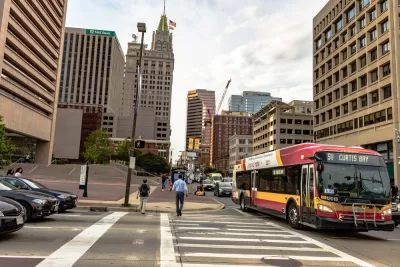
Alex Holt reports on the first draft of the much-anticipated Central Maryland Regional Transit Plan (RTP), released in April by the Maryland Department of Transportation (MDOT) and the Maryland Transit Administration (MTA).
The RTP is the first major transit plan for Baltimore and surrounding counties since the MTA’s 2002 Regional Rail Plan, so there is plenty of work to do to deliver my reliable transit service to the region, which it aims to do by focusing on small, systematic goals, according to Holt.
"The plan’s highlights include universal real-time passenger information, a completely electrified bus system with 85% on-time performance, 10 new miles of bus lanes, 2-3 'transit corridors' ready-made for bus rapid transit (BRT) or light rail in the short term, and as many as 30 such corridors in the long run," reports Holt. More details are included in the source article.
Read the full story: More bus lanes, better connections, and expanded service are a part of a new Maryland transit plan

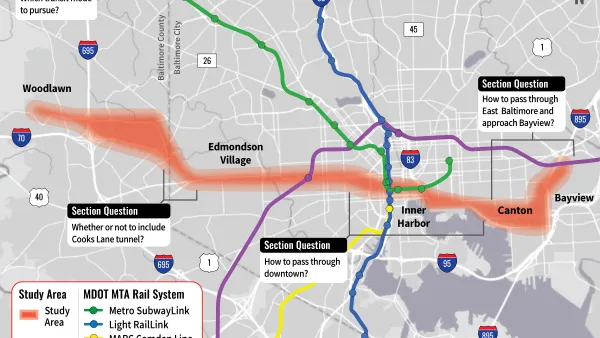
Maryland to Restart Planning for East-West Transit Line Through Baltimore
A plan for the Red Line, an east-west light rail line notoriously canceled by former-Governor Larry Hogan in 2015, is back on the table in Baltimore.
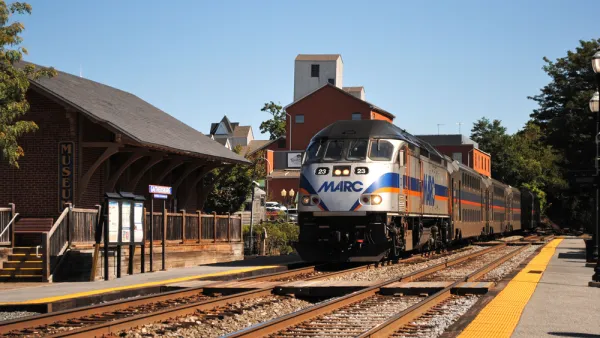
Maryland Legislators Override Governor’s Veto to Support Regional Rail Investments
The latest round of Gov. Larry Hogan v. public transit goes to the latter.

San Diego High-Speed Rail Plan Counts on Future Density
Despite slowing population growth statewide, officials believe the region will "grow into" the new rail system if cities promote dense development around transit stations.

Planetizen Federal Action Tracker
A weekly monitor of how Trump’s orders and actions are impacting planners and planning in America.

California plans to bury El Niño’s downpour
If the state plays its cards right, it may be able to store a billion acre-feet of El Niño’s water in aquifers.

Chicago breaks ground on $3 billion megadevelopment
The new neighborhood, titled Foundry Park, will one day host 3,700 residences.

Satanic place names
From streams and lakes to valleys and canyons, I mapped more than 1,000 places named after the Devil.

California High-Speed Rail Authority CEO resigns after $600,000 scandal
Under Ian Choudri, the authority used taxpayer dollars to fund first class flights and trips to nightclubs.

Want to study the Missouri River? Soon, you may need unanimous approval from 10 states
Legislation would require 10 governors’ permission to study or build projects moving water outside the basin.

FREE Course: Walkable City 1: Why Walkability?
After describing his path towards focusing on walkability as the essence of good planning, Jeff Speck marches through his five principal reasons for making more walkable places.
Reinventing Malls: Planning Alchemy—Turning Gray Fields Into Gold
The course focuses on the opportunities and imperatives that shape reinvention of mall sites.

City of Rosemead
Rutgers University, Edward J. Bloustein School of Planning and Public Policy
One Hundred Miles
Hunter College, City University of New York (CUNY)
The Architects Foundation
University of Cincinnati Online
City of Cambridge
Montrose County
The Pocatello Development Authority