The initiative focuses on safety, but fatalities are up and ridership growth is down in New York City. How is Vision Zero missing the mark?


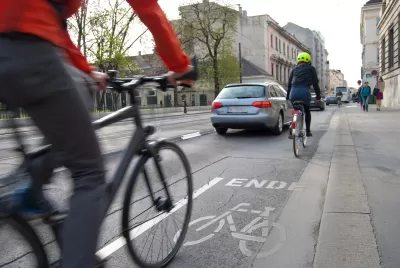
"Vision Zero is failing to have a meaningful impact because it targets the wrong goal. The logical flaw here, at least as implemented in New York City, is quite basic: it is a policy that requires dead cyclists as a prerequisite to safety improvements," writes Aaron Gordon.
He uses data from New York City to make the case that Vision Zero is not making streets safer for biking and that the city only moves quickly to make changes after a cyclist is killed. There is safety in numbers, says Gordon, but the city has put in mostly unprotected bike lanes that do not provide the kind of safe infrastructure that draws people to biking.
"But safety isn’t the only factor. So are things like convenient, secure bike parking, timing traffic lights for cycling speeds for quicker and easier journeys, good road conditions, and sensible laws that acknowledge bicycles are not cars and should follow different rules," adds Gordon.
FULL STORY: Vision Zero Is The Wrong Goal

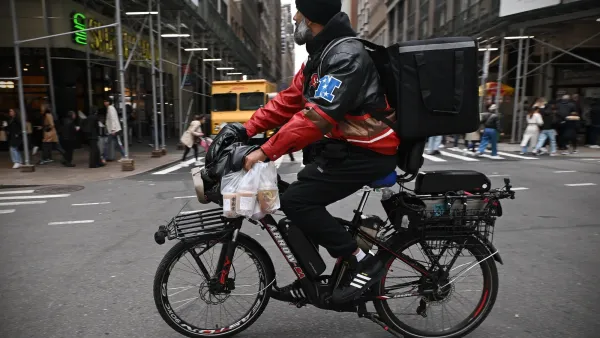
Study: Delivery Workers Are the Safest Cyclists on NYC Roads
A new study shows that delivery workers are more likely to stop at red lights and obey traffic rules than recreational or commuter riders.

Making the Golden Gate Bridge Safer for Cyclists
The Golden Gate Bridge District is looking at ways to improve safety on the bridge's narrow, windy bike and pedestrian paths.
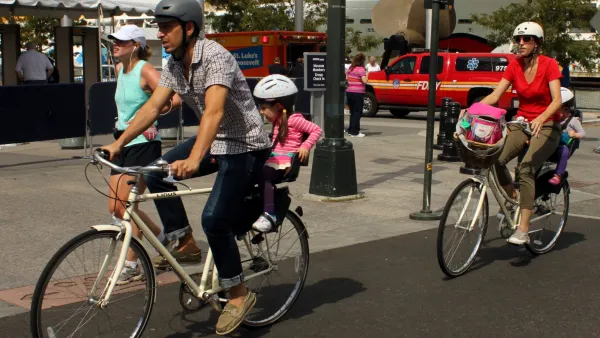
Signal Priority in N.Y.C. to Make Streets Safer for Cyclists
New York City will create green waves by adjusting traffic signals to keep cyclists moving, even when drivers will have to slow down.

The state-sanctioned urbicide of Austin
People don’t kill cities. Freeways do.

US to reduce Colorado River water deliveries to Mexico
A new Colorado Treaty amendment reduces Mexico’s Colorado River water allocation by 250,000 acre feet.

New Jersey’s second-largest city bans standalone data centers
Jersey City will continue to allow co-location facilities, such as those meant for research institutions that store their own data.

Amtrak not solely to blame for New Jersey commuter rail's unreliability, report finds
A new study from the Garden State Initiative found that NJ Transit’s budget grew 20% across a 4 year period, but reliability declined significantly over the same period.

EPA erases limits on planet-warming pollution from power plants
Under Monday’s plan, power plants would still have some limits on how much mercury, arsenic and other contaminants they can emit.

Phoenix announces new on-demand transit service, more frequent RAPID buses
Both new services will launch in October, and are part of Phoenix's Project Effective Access Solutions for Easing Congestion.

FREE Course: Walkable City 1: Why Walkability?
After describing his path towards focusing on walkability as the essence of good planning, Jeff Speck marches through his five principal reasons for making more walkable places.
Reinventing Malls: Planning Alchemy—Turning Gray Fields Into Gold
The course focuses on the opportunities and imperatives that shape reinvention of mall sites.

Eagle County Government
Harvard University Graduate School of Design
Nashville Planning Department
The Architects Foundation
University of Cincinnati Online
The Pocatello Development Authority
The Urban Renewal Agency of the City of Pocatello
Journal of the American Planning Association