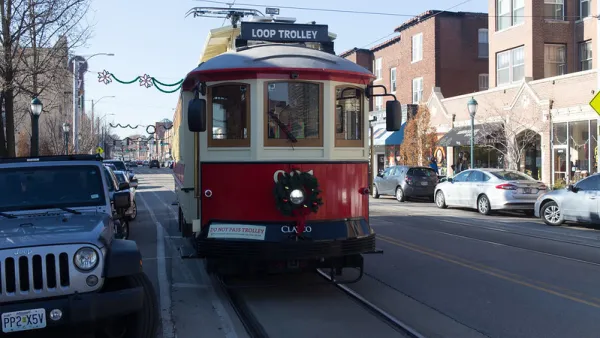
The St. Louis Loop Trolley isn't running at full capacity, yet, but it's also falling well short of its projected ridership.


[Updated October 14, 2019) Mark Schlinkmann reports from St. Louis, where, "[a]fter more than a half-year in business, the Loop Trolley’s ridership and farebox revenue is lagging as the line continues to operate on a limited-hours schedule with just two of its three cars in service."
The trolley launched service on Nov. 16, 2018, and has been operating four days a week, instead of seven as planned in early budget documents that set ridership targets. Since opening, "11,364 tickets have been sold, producing farebox revenue of $22,283," reports Schlinkmann.
The trolley's third car is underway with testing, after a delayed delivery in January, which Loop Trolley officials hope will help increase the number of people who find reason to ride the streetcar.
FULL STORY: Loop Trolley ridership and fare revenue lag — it's raised just $22,283 in fares since Nov. 16

Loop Trolley on the Ropes in St. Louis
Extremely poor ridership might be dooming the St. Louis Loop Trolley less than a year after it opened to the public.
The Uncertain Future of the St. Louis Loop Trolley
St. Louis faces losing federal funds if the Loop Trolley remains defunct. But is the 2.2-mile line worth it?
Crime, Cheap Gas, Declining Population: A Cocktail for Decreased Transit Ridership
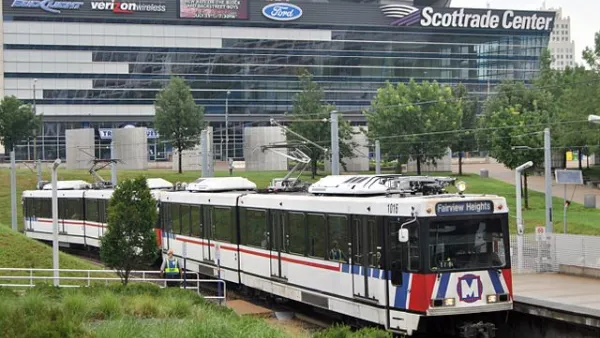
St. Louis transit planners are evaluating the reasons behind a decline in transit use as the Metro Transit system prepares its first light expansion in years.

Planetizen Federal Action Tracker
A weekly monitor of how Trump’s orders and actions are impacting planners and planning in America.

The state-sanctioned urbicide of Austin
People don’t kill cities. Freeways do.

US to reduce Colorado River water deliveries to Mexico
A new Colorado Treaty amendment reduces Mexico’s Colorado River water allocation by 250,000 acre feet.

Mamdani overhauls NYC's Vision Zero plan with 100 new policy goals
The overhaul aims to reduce traffic deaths and make streets safer for pedestrians, cyclists and drivers through lower speed limits, new safety infrastructure and more.

Amtrak not solely to blame for New Jersey commuter rail's unreliability, report finds
A new study from the Garden State Initiative found that NJ Transit’s budget grew 20% across a 4 year period, but reliability declined significantly over the same period.

EPA erases limits on planet-warming pollution from power plants
Under Monday’s plan, power plants would still have some limits on how much mercury, arsenic and other contaminants they can emit.

FREE Course: Walkable City 1: Why Walkability?
After describing his path towards focusing on walkability as the essence of good planning, Jeff Speck marches through his five principal reasons for making more walkable places.
Reinventing Malls: Planning Alchemy—Turning Gray Fields Into Gold
The course focuses on the opportunities and imperatives that shape reinvention of mall sites.


Eagle County Government
Harvard University Graduate School of Design
Nashville Planning Department
The Architects Foundation
University of Cincinnati Online
The Pocatello Development Authority
The Urban Renewal Agency of the City of Pocatello
Journal of the American Planning Association