Reducing the number of traffic lanes to improve bike and pedestrian safety can be inherently controversial when auto travel times are increased, and it can upset motorists further when they learn gas taxes are funding those safety improvements.


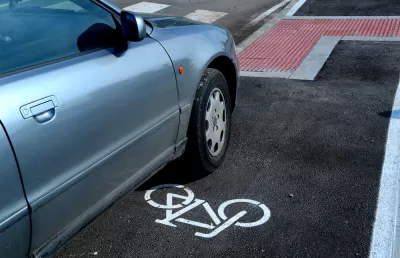
Patrick McGreevy, who covers the California Legislature out of the Sacramento bureau for the Los Angeles Times, reports on road diet controversies in Los Angeles and Sacramento, and how transportation funding is adding to the public debate, particularly since the passage of Senate Bill 1, the Road Repair and Accountability Act of 2017.
Senate Bill 1 includes $100 million in gas tax money annually designated for bicycle and pedestrian projects, which are key elements of many road diets.
The bulk of SB 1 money, $2.27 billion in the first year, went to state projects to repair and maintain roads, while $750 million annually was set aside for public transportation capital projects and operating expenses.
Annual revenue from the five tax and fee increases in SB 1 [see Figure 2: Transportation Revenue Increases on pg. 3 of LAO report (pdf)] is estimated at $5.4 billion, so the $100 million directed to the Caltrans Active Transportation Program amounts to 1.85 percent. However, the $1.5 billion that is assigned to repairs to local streets and roads may be eligible for complete streets projects.
The gas tax revenue is mainly used for the rehabilitation and replacement of roads and bridges, but some of the money can legally go to road diet projects, said Matt Rocco, a spokesman for the California Department of Transportation.
Opposition to spending gas tax funds on lane reductions comes from road diet opponents, unsurprisingly, and also at least one prominent taxpayer's group, reports McGreevy.
“The money should be used to help with congestion overall, and I don’t think that road diets help congestion. I think they cause congestion,” said Selena Inouye, board president of the Westside Los Angeles Neighbors Network, a group formed in response to Venice Boulevard’s controversial ‘road diet’ in Mar Vista to make space for a protected bicycle lane. [The project was approved prior to the passage of SB 1 in April 2017.]
Gas tax money can legally go to such projects, but that does not mean it should, said David Wolfe, legislative director for the Howard Jarvis Taxpayers Assn., which opposed the original gas tax increase and supported an unsuccessful statewide ballot measure last year to repeal it. It has since continued to watch and criticize how state and local governments are spending the money.
Wolfe’s office in Sacramento overlooks J Street, a one-way road and major traffic corridor in the city center that was recently reduced from three lanes to two. The space taken from motorists was used to create a protected bike lane buffered from traffic by parking spaces moved away from the curb.
FULL STORY: Using California gas tax to reduce traffic lanes? Not how it should be spent, some say

ICYMI: 12 States Hiked Gas Taxes on Monday
On July 1, Illinois and Ohio increased gas taxes by double digits: 19 cents per gallon and 10.5 CPG, respectively, followed by California at 5.6 CPG, all due to legislation passed this year or in 2017. Diesel tax hikes were even higher.
Democrats Balk at Gov. Newsom's Gas Tax Holiday
Saving motorists 3 cents a gallon may be a slam dunk for Republican leaders in the California legislature who opposed hiking the gas tax in the first place, but Democratic leaders are reluctant to tamper with a hard-fought legislative and ballot win.
California Gasoline Tax Rises by 4 Cents
You might have missed it as legislators didn't vote on it—not this year, anyway—despite attempts by Republicans to suspend the increase.

Planetizen Federal Action Tracker
A weekly monitor of how Trump’s orders and actions are impacting planners and planning in America.

The state-sanctioned urbicide of Austin
People don’t kill cities. Freeways do.

US to reduce Colorado River water deliveries to Mexico
A new Colorado Treaty amendment reduces Mexico’s Colorado River water allocation by 250,000 acre feet.

Mamdani overhauls NYC's Vision Zero plan with 100 new policy goals
The overhaul aims to reduce traffic deaths and make streets safer for pedestrians, cyclists and drivers through lower speed limits, new safety infrastructure and more.

Amtrak not solely to blame for New Jersey commuter rail's unreliability, report finds
A new study from the Garden State Initiative found that NJ Transit’s budget grew 20% across a 4 year period, but reliability declined significantly over the same period.

EPA erases limits on planet-warming pollution from power plants
Under Monday’s plan, power plants would still have some limits on how much mercury, arsenic and other contaminants they can emit.

FREE Course: Walkable City 1: Why Walkability?
After describing his path towards focusing on walkability as the essence of good planning, Jeff Speck marches through his five principal reasons for making more walkable places.
Reinventing Malls: Planning Alchemy—Turning Gray Fields Into Gold
The course focuses on the opportunities and imperatives that shape reinvention of mall sites.

Eagle County Government
Harvard University Graduate School of Design
Nashville Planning Department
The Architects Foundation
University of Cincinnati Online
The Pocatello Development Authority
The Urban Renewal Agency of the City of Pocatello
Journal of the American Planning Association