Monday marked the first time King County Metro Transit has deployed its almost-decade-old plan to deal with winter conditions.


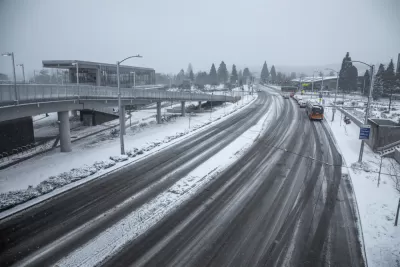
"Monday is the first commute day that King County Metro Transit has implemented its 'Emergency Snow Network,' which reduced the usual 237 routes to just 60 high-ridership, low-slope bus corridors [pdf]," reports Mike Lindbloom.
"Overall trips are about 40 percent of normal, on routes that normally carry 65 percent of Metro’s ridership of just more than 400,000 boardings per day, the agency says. That means many commuters on local routes, for instance in steep areas like Queen Anne Hill, often walk to busier routes," adds Linblom.
The city's Emergency Snow Network plan was created after a December 2008 storm. At the time, the city "treated the roads with sand, not salt, and Metro improvised by cutting service in half."
"At one point, 200 buses were abandoned on streets and Metro estimated a $1.5 million loss for damage and worker overtime."
FULL STORY: Which Metro buses are running during Seattle’s big snowstorm?

Shared Mobility Riders in Seattle to Get Free Transit Trips
Riders who park Lime bikes or scooters at one of 14 designated Link light rail stations can earn free trips on the region’s transit systems.
Sooner Rather Than Later: Support Builds for Eastside-Only Light Rail in Seattle
The Eastside Link light rail route, now known as Line 2, is delayed. A Sound Transit board officials is suggesting that some of the route can open soon, while the rest of the route is prepped to open later.
A ‘Playbook’ for Better Bus Service, From King County Metro
King County Metro operates one of the nation’s busiest transit systems—without running any trains. The agency recently released a playbook as a guide to transit service.

The state-sanctioned urbicide of Austin
People don’t kill cities. Freeways do.

US to reduce Colorado River water deliveries to Mexico
A new Colorado Treaty amendment reduces Mexico’s Colorado River water allocation by 250,000 acre feet.

New Jersey’s second-largest city bans standalone data centers
Jersey City will continue to allow co-location facilities, such as those meant for research institutions that store their own data.

Amtrak not solely to blame for New Jersey commuter rail's unreliability, report finds
A new study from the Garden State Initiative found that NJ Transit’s budget grew 20% across a 4 year period, but reliability declined significantly over the same period.

EPA erases limits on planet-warming pollution from power plants
Under Monday’s plan, power plants would still have some limits on how much mercury, arsenic and other contaminants they can emit.

Phoenix announces new on-demand transit service, more frequent RAPID buses
Both new services will launch in October, and are part of Phoenix's Project Effective Access Solutions for Easing Congestion.

FREE Course: Walkable City 1: Why Walkability?
After describing his path towards focusing on walkability as the essence of good planning, Jeff Speck marches through his five principal reasons for making more walkable places.
Reinventing Malls: Planning Alchemy—Turning Gray Fields Into Gold
The course focuses on the opportunities and imperatives that shape reinvention of mall sites.

Eagle County Government
Harvard University Graduate School of Design
Nashville Planning Department
The Architects Foundation
University of Cincinnati Online
The Pocatello Development Authority
The Urban Renewal Agency of the City of Pocatello
Journal of the American Planning Association