California and Massachusetts use the same name for climate change legislation, Global Warming Solutions Act, and set the same target date for reductions, 2020. Both achieved their targets 2016, but the Bay State had a tougher goal to meet.


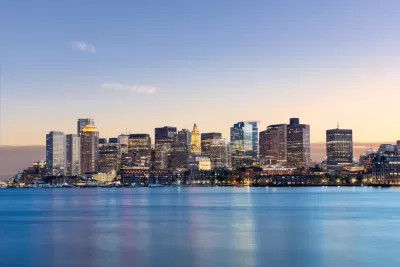
The Global Warming Solutions Act of 2008 (aka Chapter 298) was signed into law by Mass. Gov. Deval Patrick (D). See (and listen to) Adam Reilly's July 2017 WGBH interview on WGBH of Sen. Marc R. Pacheco (D-Taunton), the law's author, and David Ismay, a senior attorney at the Conservation Law Foundation, which successfully took the state to court, for background on the landmark law.
The Massachusetts law is stronger than California's Global Warming Solutions Act of 2006 (aka Assembly Bill 32) in two important ways:
- It calls for greenhouse gas (GHG) reductions "between 10 percent and 25 percent below statewide 1990 GHG emission levels by 2020," while AB 32 just called for reduction to "1990 levels."
- It set a future target date of "80 percent below statewide 1990 GHG emission levels by 2050."
It it true that both California Govs. Schwarzenegger (R) and Brown (D) did call for the same 2050 goal, but those were in the form of executive orders [S-3-05 (pdf) and B-30-15, respectively] as opposed to legislation. Senate Bill 32, approved by the legislature in 2016, extended California's climate law to 2030, calling for reductions to 40 percent below 1990 levels.
Benjamin Swasey of WBUR reports on Jan. 4 that greenhouse gas emissions in Massachusetts declined 2.5 percent in 2016, the year of the most recent greenhouse gas inventory, from 2015. According to the Department of Environmental Protection (MassDEP), emissions decreased by 21% between 1990 and 2016.
By contrast, it was widely reported last July that California had reduced its 2016 emissions, also its most recent GHG inventory, to 1990 levels, meeting its AB 32 goal four years early.
Transportation is tops
Another similarity between the two states – the transportation sector is the largest source of emissions, at 39 percent in Massachusetts and 41 percent in California.
Last month, the Bay State joined with eight other East Coast states and the District of Columbia to develop a policy to price emissions from transportation, set a 'cap' on them, and invest the revenues in low carbon transportation solutions, similar to what California has been doing since 2015 when transportation fuel was added to the cap-and-trade program.
Additional reading: "Climate Change Law in California and Massachusetts: Lessons for State Policy Makers" [pdf], Hastings Environmental Law Journal, Jan 1, 2015.
FULL STORY: The State's Emissions Declined 2.5 Percent In 2016. They're Now 21 Percent Below 1990 Levels


California Achieved its Climate Goal; Now the Hard Part Begins
New York Times climate reporter, Brad Plumer, comments on California's landmark accomplishment in reducing emissions, observing that with the low-hanging electricity generation fruit picked, reducing transportation emissions will prove formidable.
California Progress Report: GDP Increases While GHGs Fall
California is demonstrating that improving the economy and the environment go hand in hand. A new inventory report from the state's Air Resources Board notes changes in gross domestic product, population, and greenhouse gas emissions since 2000.
Another Key Climate Bill Lost in California
On the heels of losing an oil reduction mandate due to lobbying by Big Oil, another key climate bill failed to pass—setting greenhouse gas reduction targets beyond 2020. An oil pipeline safety bill resulting from Santa Barbara spill passed.

The state-sanctioned urbicide of Austin
People don’t kill cities. Freeways do.

US to reduce Colorado River water deliveries to Mexico
A new Colorado Treaty amendment reduces Mexico’s Colorado River water allocation by 250,000 acre feet.

New Jersey’s second-largest city bans standalone data centers
Jersey City will continue to allow co-location facilities, such as those meant for research institutions that store their own data.

Amtrak not solely to blame for New Jersey commuter rail's unreliability, report finds
A new study from the Garden State Initiative found that NJ Transit’s budget grew 20% across a 4 year period, but reliability declined significantly over the same period.

EPA erases limits on planet-warming pollution from power plants
Under Monday’s plan, power plants would still have some limits on how much mercury, arsenic and other contaminants they can emit.

Phoenix announces new on-demand transit service, more frequent RAPID buses
Both new services will launch in October, and are part of Phoenix's Project Effective Access Solutions for Easing Congestion.

FREE Course: Walkable City 1: Why Walkability?
After describing his path towards focusing on walkability as the essence of good planning, Jeff Speck marches through his five principal reasons for making more walkable places.
Reinventing Malls: Planning Alchemy—Turning Gray Fields Into Gold
The course focuses on the opportunities and imperatives that shape reinvention of mall sites.

Eagle County Government
Harvard University Graduate School of Design
Nashville Planning Department
The Architects Foundation
University of Cincinnati Online
The Pocatello Development Authority
The Urban Renewal Agency of the City of Pocatello
Journal of the American Planning Association