Four mayors hammer home the point that moving to 100 percent clean energy on the municipal level is environmentally, economically, and politically desirable.



"Over the past few years," four mayors write, "100 cities and towns across the country — such as those we represent: Columbia, South Carolina; Salt Lake City, Utah; and San Diego and San Francisco, California — have committed to power our cities on 100 percent clean, renewable energy like solar and wind."
The mayors, Columbia's Steve Benjamin, Salt Lake City's Jackie Biskupski, San Francisco's London Breed, and San Diego's Kevin Faulconer, co-chair the Sierra Club's Mayors For 100% Clean Energy campaign.
Emphasizing that roughly one in seven Americans live in places making the transition to 100 percent renewable energy, they cite the position's political advantages, on top of environmental and economic ones. They write, "Recent polls show that public support for 100 percent renewable energy is at an all-time high, and power providers are taking note. According to a survey conducted on behalf of Edison Electric Institute, a utility industry think-tank, over 80 percent of the population believes 100 percent clean energy is the right thing to do."
FULL STORY: One Hundred Cities Are Leading the Way to 100 Percent Clean Energy

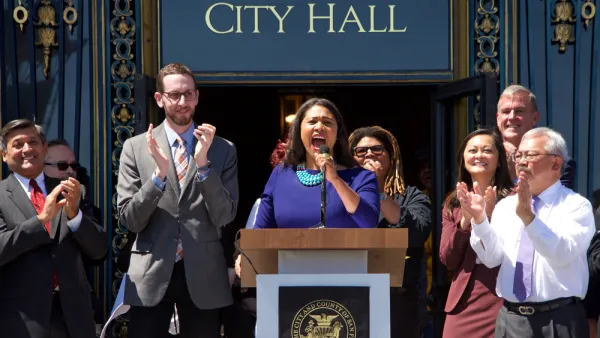
San Francisco's Next Mayor a Self-Described 'Pro-Housing' Politician With Support From YIMBYs
London Breed is the first African American female elected mayor of San Francisco, and she brings high hopes that a pro-development approach can help mitigate the city's housing affordability crisis.
Court unfreezes $20B in federal climate grants
A U.S. Court of Appeals ruled that the Trump administration potentially violated the Inflation Reduction Act by attempting to claw back grants awarded under the Greenhouse Gas Reduction Fund program.

A desolate patch of Southern California desert could become a lithium powerhouse
Plans to develop lithium mines and data centers are dividing residents of a remote Southern California region.

Planetizen Federal Action Tracker
A weekly monitor of how Trump’s orders and actions are impacting planners and planning in America.

The state-sanctioned urbicide of Austin
People don’t kill cities. Freeways do.

US to reduce Colorado River water deliveries to Mexico
A new Colorado Treaty amendment reduces Mexico’s Colorado River water allocation by 250,000 acre feet.

5 New England states march closer to 800 megawatt wind energy project
Securing federal approval for the project may be complicated under the Trump administration, which has historically been hostile towards domestic wind power.

Baltimore to break ground on $50 million Transit Priority Project
The project will bring faster bus trips, safer streets and better bike connections to Baltimore.

Airbnb launches $250 million 'last-dollar financing' housing accelerator, makes first investment in Austin
The company will put $6.4 million towards affordable housing development in Texas’ capital.

FREE Course: Walkable City 1: Why Walkability?
After describing his path towards focusing on walkability as the essence of good planning, Jeff Speck marches through his five principal reasons for making more walkable places.
Reinventing Malls: Planning Alchemy—Turning Gray Fields Into Gold
The course focuses on the opportunities and imperatives that shape reinvention of mall sites.

Eagle County Government
Harvard University Graduate School of Design
Nashville Planning Department
The Architects Foundation
University of Cincinnati Online
The Pocatello Development Authority
The Urban Renewal Agency of the City of Pocatello
Journal of the American Planning Association