The Hop will deliver new transit service on the east side of downtown Milwaukee. The Hop comes also serves big development expectations from local officials.


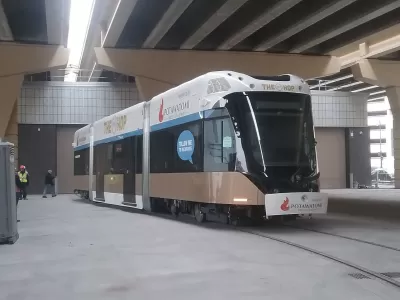
"The first public rides on The Hop were on time and began with a bit of a jolt and a whiff of new car smell Monday," reports James B. Nelson.
Journalists and city officials got a first look at the new streetcar a few days before the city's new streetcar line opened to the public on November 2.
Mayor Tom Barrett was on the ride earlier this week, touting the streetcar as a development and property tax catalyst for the city. "The mayor ticked off numerous commercial developments along the route, including the new 25-story BMO Tower office being built at 790 North Water St. and revamping of the Milwaukee Athletic Club, 758 North Broadway," according to Nelson.
A separate article by Nelson lists the essential facts about the new streetcar system. "On Friday, the $124 million Milwaukee streetcar officially becomes part of the transportation landscape," writes Nelson. "[A] 2.5-mile network of tracks and overhead wires has been laid and five 67-foot cars delivered. The Hop will run on a loop through downtown and the Historic Third Ward between the Milwaukee Intermodal Station, 433 W. St. Paul Ave., and Burns Commons, at East Ogden and North Prospect avenues."
More info in the article includes The Hop's route, its intended ridership, the political context that produced the final product (and a planned extension), and the benchmarks of success, once the system has some miles under its belt.
Read the full story: Everything you need to know about the new Milwaukee streetcar, at least for now
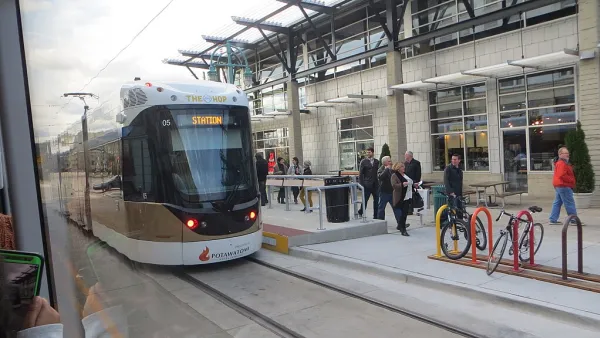
As Local Pols Call for Defunding, Milwaukee Streetcar Breaks Post-Pandemic Ridership Record
The free ‘The Hop’ streetcar has served over 3.2 million riders since it launched in late 2018.
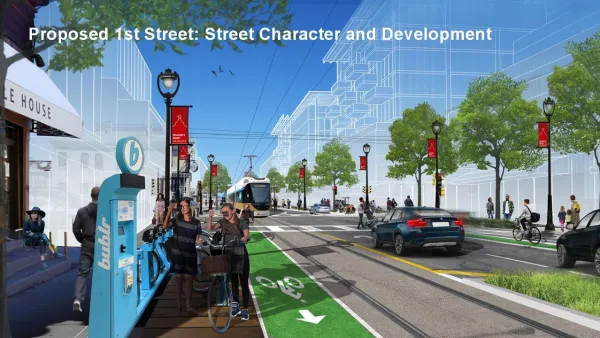
Progress Slow for Milwaukee's Streetcar Extension
Milwaukee's mayor has a $160 million plan to extend The Hop streetcar, but the proposal so far lacks the necessary political support.
Land Use Planning Precedes Streetcar Extension in Milwaukee
Plans to extend Milwaukee's The Hop streetcar line are still years away from fruition, but the city is already at work on development plans to make the most of the opportunity.

Planetizen Federal Action Tracker
A weekly monitor of how Trump’s orders and actions are impacting planners and planning in America.

California plans to bury El Niño’s downpour
If the state plays its cards right, it may be able to store a billion acre-feet of El Niño’s water in aquifers.

Desperate measures: Advocates weigh draining Lake Powell to fill Colorado River
Draining the reservoir could reduce evaporation losses by a couple hundred thousand acre-feet.

US buildings threatened, destroyed by fires set to triple by 2060
Researchers found a high fire risk for socioeconomically vulnerable neighborhoods in the American West.

LA residents may be allowed to paint their own crosswalks
Councilwoman Katy Yaroslavsky put out a motion instructing the Los Angeles Department of Public Transportation to study the feasibility of allowing volunteers to paint crosswalks.

Dallas moves to overhaul its zoning code
The city's zoning reform will allow more multi-family and mixed-use developments.

FREE Course: Walkable City 1: Why Walkability?
After describing his path towards focusing on walkability as the essence of good planning, Jeff Speck marches through his five principal reasons for making more walkable places.
Reinventing Malls: Planning Alchemy—Turning Gray Fields Into Gold
The course focuses on the opportunities and imperatives that shape reinvention of mall sites.

City of Rosemead
Rutgers University, Edward J. Bloustein School of Planning and Public Policy
One Hundred Miles
Hunter College, City University of New York (CUNY)
The Architects Foundation
University of Cincinnati Online
City of Cambridge
Montrose County
The Pocatello Development Authority