An historically successful group of transit and density opponents in Los Angeles have set their sights on a plan that would add density along the Expo Line in West Los Angeles.


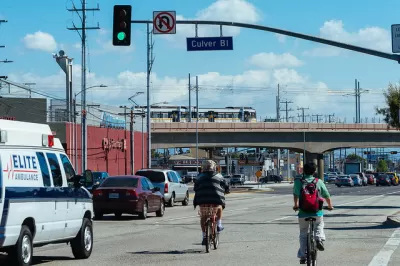
"A Westside nonprofit has sued the city of Los Angeles, seeking to overturn a plan that would allow the construction of up to 6,000 new apartment and condominium units within a half-mile of five Metro Expo Line stations," reports Laura J. Nelson. The Exposition Corridor Transit Neighborhood Plan (technically a Specific Plan in the legal parlance of the city of Los Angeles) was approved in June 2018.
"The advocacy group Fix the City argued in a complaint filed Thursday that Los Angeles should not have approved the Expo Line density plan without first assessing and fixing West L.A.’s 'overburdened and inadequate infrastructure,'" adds Nelson.
Fix the City has a history of using the legal system to obstruct planning efforts in the city of Los Angeles, suing the city for Mobility Plan 2035 and eventually causing the city to rescind the plan and start over. Fix the City also helped successfully block the Hollywood Community Plan in 2012.
The article includes more details on what kinds of development are called for in the Exposition Corridor Transit Neighborhood Plan and the grounds for Fix the City's lawsuit against the city.
FULL STORY: Lawsuit seeks to overturn plan that would allow taller buildings along the Metro Expo Line

LA Times: City Council Should Take Responsibility for Lack of Transit Oriented Development
The Los Angeles Times editorial board has strong words for the Los Angeles City Council about planning for transit oriented development.
Anti-Development Forces Strike at L.A.'s Transit Oriented Communities Program
There's a new front in the city of L.A.'s ongoing conflict between anti-development forces and efforts to add density at and around transit.
Designing a Multi-Modal, User-Focused TOD Vision for Los Angeles' Expo Line
Facing explosive development interest around its Metro station, the small city of Culver on L.A.’s Westside is taking steps to shape its mobility future.

Planetizen Federal Action Tracker
A weekly monitor of how Trump’s orders and actions are impacting planners and planning in America.

The state-sanctioned urbicide of Austin
People don’t kill cities. Freeways do.

US to reduce Colorado River water deliveries to Mexico
A new Colorado Treaty amendment reduces Mexico’s Colorado River water allocation by 250,000 acre feet.

Mamdani overhauls NYC's Vision Zero plan with 100 new policy goals
The overhaul aims to reduce traffic deaths and make streets safer for pedestrians, cyclists and drivers through lower speed limits, new safety infrastructure and more.

Amtrak not solely to blame for New Jersey commuter rail's unreliability, report finds
A new study from the Garden State Initiative found that NJ Transit’s budget grew 20% across a 4 year period, but reliability declined significantly over the same period.

EPA erases limits on planet-warming pollution from power plants
Under Monday’s plan, power plants would still have some limits on how much mercury, arsenic and other contaminants they can emit.

FREE Course: Walkable City 1: Why Walkability?
After describing his path towards focusing on walkability as the essence of good planning, Jeff Speck marches through his five principal reasons for making more walkable places.
Reinventing Malls: Planning Alchemy—Turning Gray Fields Into Gold
The course focuses on the opportunities and imperatives that shape reinvention of mall sites.

Eagle County Government
Harvard University Graduate School of Design
Nashville Planning Department
The Architects Foundation
University of Cincinnati Online
The Pocatello Development Authority
The Urban Renewal Agency of the City of Pocatello
Journal of the American Planning Association