In the face of potential federal funding cuts, CDOT leaders reasserted their commitment to planned bus rapid transit projects.


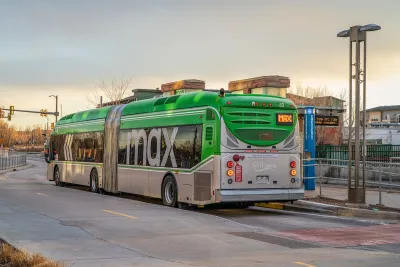
Colorado lawmakers are working to create a bus rapid transit (BRT) grant program to keep up with its BRT expansion plan if federal funding is cut, reports Nathaniel Minor for Colorado Public Radio.
According to Minor, the fund would direct revenue earned from rider-hailing and delivery fees to a BRT fund. “The money, however, won’t be enough to offset the potential loss of federal funding. CDOT officials have requested nearly $150 million in federal ‘Small Starts’ grant funding for just one BRT project — a planned $320 million line along about 18 miles of Federal Boulevard in Denver and nearby suburbs including Englewood and Westminster.”
CDOT is also exploring ways to cut costs on the BRT project while continuing with its plans. Cuts could affect station design and amenities, said retired transportation planner Debra Baskett. “In an email to stakeholders, CDOT said a non-federally funded project would need to be smaller and potentially broken into smaller phases but that it and its local partners are ‘committed to delivering high-quality BRT.’”
FULL STORY: With federal funding in question, Colorado will boost state spending for bus rapid transit projects

Trump Administration Proposes to Divert Billions from Mass Transit to Highways; Advocates Sound Alarm
Two proposals from the Trump DOT would eliminate a federal mass transit fund and make it harder for states to allocate funding to transit projects.
Judge Extends NYC Congestion Pricing Through at Least June 9
A federal judge halted the Trump administration’s effort to kill the program, which remains in limbo as a lawsuit filed by the MTA moves forward.
Trump budget slashes passenger rail funding by 82%
The White House's proposed FY2027 budget makes drastic cuts to public transit and eliminates high-speed rail funding altogether.

Planetizen Federal Action Tracker
A weekly monitor of how Trump’s orders and actions are impacting planners and planning in America.

The state-sanctioned urbicide of Austin
People don’t kill cities. Freeways do.

US to reduce Colorado River water deliveries to Mexico
A new Colorado Treaty amendment reduces Mexico’s Colorado River water allocation by 250,000 acre feet.

Airbnb launches $250 million 'last-dollar financing' housing accelerator, makes first investment in Austin
The company will put $6.4 million towards affordable housing development in Texas’ capital.

Guerilla urbanists are building DIY bus stop benches in Chicago
A before-and-after of one of the bus stops with a new bench. The new benches are not officially sanctioned or permitted, but the residents who placed them hope they will be the start of a network of DIY benches across the city.

Mamdani overhauls NYC's Vision Zero plan with 100 new policy goals
The overhaul aims to reduce traffic deaths and make streets safer for pedestrians, cyclists and drivers through lower speed limits, new safety infrastructure and more.

FREE Course: Walkable City 1: Why Walkability?
After describing his path towards focusing on walkability as the essence of good planning, Jeff Speck marches through his five principal reasons for making more walkable places.
Reinventing Malls: Planning Alchemy—Turning Gray Fields Into Gold
The course focuses on the opportunities and imperatives that shape reinvention of mall sites.

Eagle County Government
Harvard University Graduate School of Design
Nashville Planning Department
The Architects Foundation
University of Cincinnati Online
The Pocatello Development Authority
The Urban Renewal Agency of the City of Pocatello
Journal of the American Planning Association