Nearly half of pedestrians who died after being hit by the front of a vehicle were struck by SUVs or trucks.



The National Highway Traffic Safety Administration (NHTSA) is proposing a new rule that would require automakers to take pedestrian safety into account when designing cars. According to an Associated Press article by Tom Krisher, the proposed rule would include all passenger vehicles under 10,000 pounds but is particularly targeted at large SUVs and pickup trucks, which have grown larger in recent years, with accompanying larger blind spots.
Almost half of pedestrian deaths when hit by the front of a vehicle are caused by trucks or SUVs, according to agency data. The NHTSA says the rule could save at least 67 lives per year. The rule would set regulations for vehicle testing to simulate ‘head-to-hood impact’ and reduce the risk of head injuries.
The agency recently changed its policy to begin requiring testing with crash test dummies that simulate female bodies after decades of safety tests only using dummies based on male bodies. The proposed rule would require testing with female and child simulations.
Read the full story: US seeks new pedestrian safety rules aimed at increasingly massive SUVs and pickup trucks
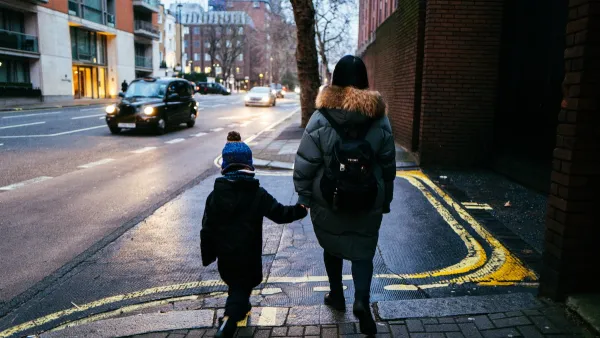
Study: Large SUVs Double Risk of Death for Children Under 10
New research from the United Kingdom reveals the higher risk of larger vehicles for pedestrians and cyclists.
NHTSA Cuts Could Make Roads More Dangerous
The agency is losing almost half of the team that oversees autonomous vehicle safety, among dozens of other key personnel.
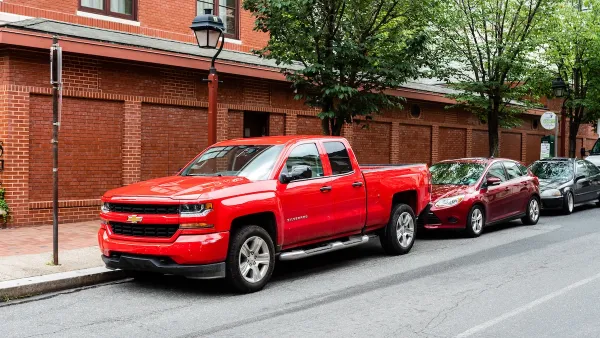
Heavier Vehicles Don’t Keep Passengers Safer
A new study shows that modern safety features are more important than size and weight once vehicles weigh over 4,000 pounds.

Planetizen Federal Action Tracker
A weekly monitor of how Trump’s orders and actions are impacting planners and planning in America.

California plans to bury El Niño’s downpour
If the state plays its cards right, it may be able to store a billion acre-feet of El Niño’s water in aquifers.

Desperate measures: Advocates weigh draining Lake Powell to fill Colorado River
Draining the reservoir could reduce evaporation losses by a couple hundred thousand acre-feet.

Mamdani’s pied-à-terre tax survives legal challenge
A panel of judges found that the plaintiffs failed to demonstrate injury as a result of New York City's implementation of the tax.

Eastern Nebraska is running out of electricity
Data centers and electrification are straining eastern Nebraska’s grid, throttling economic development.

Seattle passes record-breaking transit services expansion
Proposition 1 will double the city’s transit tax to add 95,000 more bus trips and preserve 180,000 bus trips annually.

FREE Course: Walkable City 1: Why Walkability?
After describing his path towards focusing on walkability as the essence of good planning, Jeff Speck marches through his five principal reasons for making more walkable places.
Reinventing Malls: Planning Alchemy—Turning Gray Fields Into Gold
The course focuses on the opportunities and imperatives that shape reinvention of mall sites.

City of Rosemead
Rutgers University, Edward J. Bloustein School of Planning and Public Policy
One Hundred Miles
University of Michigan School for Environment and Sustainability (SEAS)
Hunter College, City University of New York (CUNY)
The Architects Foundation
City of Cambridge
Montrose County
The Pocatello Development Authority