Despite promises to make the city’s roadways safer for pedestrians and cyclists, the proposed budget slashes Vision Zero funding nearly in half.


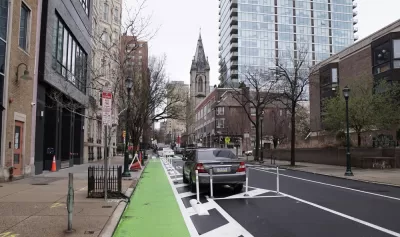
The first proposed budget under Philadelphia Mayor Cherelle L. Parker dramatically cuts funding for Vision Zero efforts, reports Thomas Fitzgerald in The Philadelphia Inquirer.
The new budget brings the Vision Zero commitment down from $15 million to $9 million over the next six years. “Safety advocates have raised concerns, chiefly that there will be fewer transformative street redesigns such as ‘road diets,’ the narrowing of traffic lanes; improving sight lines at intersections by removing parking around intersections; and bicycle lanes.”
The proposed budget does include new speed enforcement cameras along Broad Street, a roadway with a high rate of injury crashes. “A state law enacted last December authorizes the city to set up speed-enforcement cameras on five dangerous traffic corridors, adding to those already stationed along Roosevelt Boulevard. Crashes, injuries and average traffic speeds have dropped there.”
FULL STORY: Mayor Parker’s budget slashes funding for Vision Zero, a program designed to end traffic death

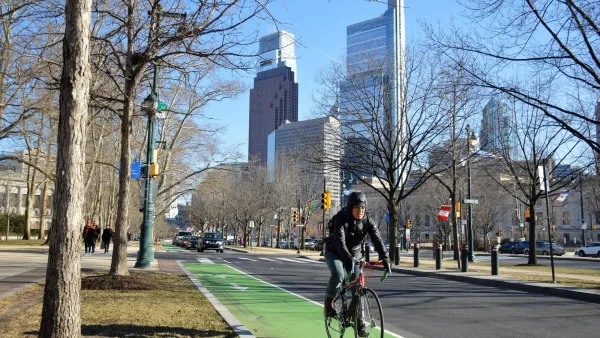
Philly Road Safety Advocates Call for Action From the City
Mayor Parker’s administration is proposing massive cuts to the city’s Vision Zero program while pedestrian and cyclist deaths remain high.
Why a Complete Streets Makeover Went Awry in Philadelphia
The city pulled the plug on a proposed street redesign after community groups criticized the public engagement process for not listening to all local voices.
Southeast LA Road Safety Advocates Call for Improved Infrastructure
Streets in southeastern Los Angeles County have a severe lack of protected bike lanes and traffic safety measures, leading to high numbers of fatalities in a community where many residents depend on walking and biking for daily needs.

Planetizen Federal Action Tracker
A weekly monitor of how Trump’s orders and actions are impacting planners and planning in America.

The state-sanctioned urbicide of Austin
People don’t kill cities. Freeways do.

US to reduce Colorado River water deliveries to Mexico
A new Colorado Treaty amendment reduces Mexico’s Colorado River water allocation by 250,000 acre feet.

Mamdani overhauls NYC's Vision Zero plan with 100 new policy goals
The overhaul aims to reduce traffic deaths and make streets safer for pedestrians, cyclists and drivers through lower speed limits, new safety infrastructure and more.

Amtrak not solely to blame for New Jersey commuter rail's unreliability, report finds
A new study from the Garden State Initiative found that NJ Transit’s budget grew 20% across a 4 year period, but reliability declined significantly over the same period.

EPA erases limits on planet-warming pollution from power plants
Under Monday’s plan, power plants would still have some limits on how much mercury, arsenic and other contaminants they can emit.

FREE Course: Walkable City 1: Why Walkability?
After describing his path towards focusing on walkability as the essence of good planning, Jeff Speck marches through his five principal reasons for making more walkable places.
Reinventing Malls: Planning Alchemy—Turning Gray Fields Into Gold
The course focuses on the opportunities and imperatives that shape reinvention of mall sites.

Eagle County Government
Harvard University Graduate School of Design
Nashville Planning Department
The Architects Foundation
University of Cincinnati Online
The Pocatello Development Authority
The Urban Renewal Agency of the City of Pocatello
Journal of the American Planning Association