Transit riders in Madison, Wisconsin are navigating an entirely new system this week.


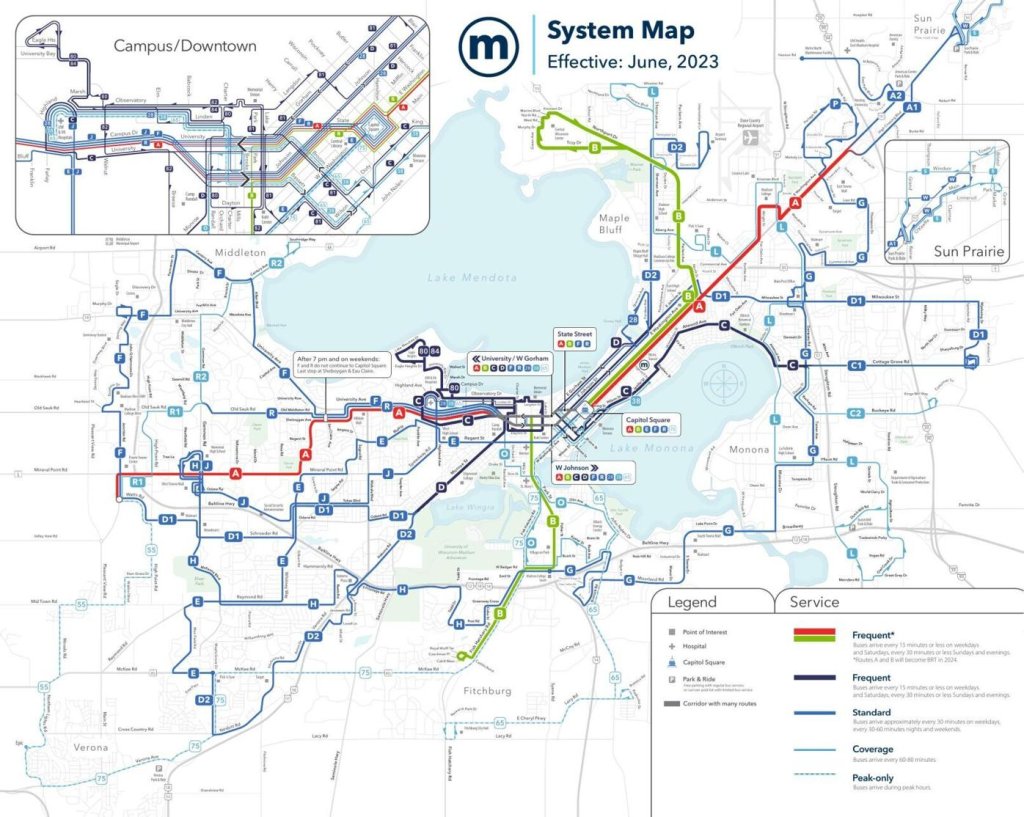
Metro Transit in Madison, Wisconsin launched redesigned transit service on June 11—the city’s first transit system redesign in 20 years.
“The city says the changes are meant to shorten commutes and simplify routes,” reports Grace Ulch for WKOW. “The biggest changes riders should expect - many route numbers have changed to letters, new bus stops have been added and Metro's north, east and west transfer points are now closed,” ads Ulch.
A separate article by Allison Garfield for Cap Times, published in May, provides additional details about the system redesign.
“The new bus redesign promises more consistent service with direct routes to outlying areas and the elimination of transfer points and buses from lower State Street,” writes Garfield. “The expansion will include three new routes to Sun Prairie. Bus rapid transit — a completely separate project that is slated to start in the fall of 2024 — will serve as the backbone going east to west and north to south.”
According to both articles, transit users in Madison have expressed concerns about the changes, with officials and some riders disagreeing on the effects of the changes for low-income riders and those with disabilities. According to Garfield, “residents have raised concerns that the system puts a disproportionate burden on low-income riders, people with disabilities and marginalized communities.”
Metro Transit’s General Manager Justin Stuehrenberg claims the opposite is true, however. “On average, Black residents will see a 96% increase in access to jobs within a 45-minute ride, Stuehrenberg said at the Thursday press conference, and for Latinx residents, that number jumps to 120%. Low-income residents will see a 93% increase.”
Newly hired “Ride Guide” staff have been on hand to help the public navigate the redesigned system, according to a city press release.
The Madison City Council first approved the new transit system design in June 2022, but full approval, in December 2022, had to wait until the city completed a Title VI evaluation.
FULL STORY: 'It's a positive change for us': Metro transit system gets its first major redesign in 20 years

Madison Redesigning its Transit System, BRT Included
Transit service in the Wisconsin State Capital has been redesigned on a high-frequency grid.
New York's Bus System Redesign—Delayed by the Pandemic—Moves Forward Again
A plan to redesign the bus system in New York City for faster, more frequent service is off the shelf and moving forward again after being paused at the beginning fo the pandemic.

New Orleans Weighs Regional Transit Plan
A new proposal would improve wait times for area buses and bring more households within walking distance to transit stops.

The state-sanctioned urbicide of Austin
People don’t kill cities. Freeways do.

US to reduce Colorado River water deliveries to Mexico
A new Colorado Treaty amendment reduces Mexico’s Colorado River water allocation by 250,000 acre feet.

New Jersey’s second-largest city bans standalone data centers
Jersey City will continue to allow co-location facilities, such as those meant for research institutions that store their own data.

Amtrak not solely to blame for New Jersey commuter rail's unreliability, report finds
A new study from the Garden State Initiative found that NJ Transit’s budget grew 20% across a 4 year period, but reliability declined significantly over the same period.

EPA erases limits on planet-warming pollution from power plants
Under Monday’s plan, power plants would still have some limits on how much mercury, arsenic and other contaminants they can emit.

Phoenix announces new on-demand transit service, more frequent RAPID buses
Both new services will launch in October, and are part of Phoenix's Project Effective Access Solutions for Easing Congestion.

FREE Course: Walkable City 1: Why Walkability?
After describing his path towards focusing on walkability as the essence of good planning, Jeff Speck marches through his five principal reasons for making more walkable places.
Reinventing Malls: Planning Alchemy—Turning Gray Fields Into Gold
The course focuses on the opportunities and imperatives that shape reinvention of mall sites.

Eagle County Government
Harvard University Graduate School of Design
Nashville Planning Department
The Architects Foundation
University of Cincinnati Online
The Pocatello Development Authority
The Urban Renewal Agency of the City of Pocatello
Journal of the American Planning Association