Legislation to enable the addition of express toll lanes on Interstate 55 in the Southwest Side of Chicago, opposed by environmental justice advocates, cleared the Illinois General Assembly last month.


“Illinois lawmakers have cleared a path forward for a long-discussed expansion of I-55, despite concerns from neighbors and environmental groups about the way the project could be funded and the repercussions of adding more lanes to the expressway,” reports Sarah Freishtat for the Chicago Tribune on May 26.
In the final weeks of the legislative session, lawmakers moved to allow the Illinois Department of Transportation to pursue a public-private partnership to complete an expansion of I-55. Such a partnership, which would allow private investment in proposed new toll lanes on the expressway, is one way IDOT could secure funding to move the project forward.
The proposed expansion could include adding express toll lanes to the highway, which runs through part of Chicago’s Southwest Side and on toward Joliet.
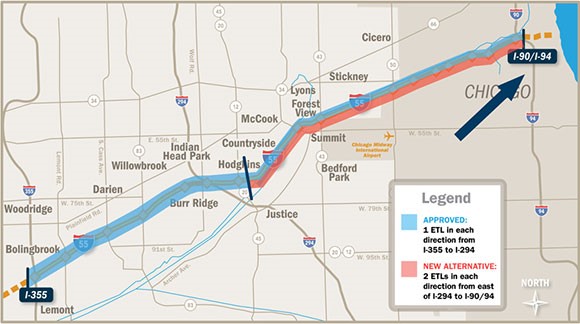
Flash back five years when Planetizen editor James Brasuell was following the project :
- Federal Approval, But No Funding for Chicago Toll Lanes, August 25, 2017
Though the federal government approved the plan for toll lanes, called managed lanes in Illinois, the state lacks the funding to implement the idea. Two toll lane proposals are currently in limbo. - Illinois DOT Expands its I-55 Express Lane Ambitions, December 11, 2017
A proposal to add express lanes on a notoriously congested stretch of I-55 that passes through the western Chicago suburbs could expand from $25 million to $700 million with the addition of an extra toll lane.
Transportation legislation
An article for Chicago's PBS station, WTTW, that focused largely on the opposition to the project, also provided the legislative details.
“House Bill 2878 and House Joint Resolution 23 (HJR23) both include provisions that would expand the scope of public-private infrastructure partnerships, in effect ceding a portion of control over planning and development to private entities, opponents said during a press conference Tuesday,” reported Patty Wetli on May 25.
Environmental justice activists from Chicago communities located along the I-55 corridor said more lanes for vehicles would only lead to more pollution and more congestion in neighborhoods already over-burdened with emissions from trucks and cars. Activists called, instead, for the state to stretch its imagination and dream up holistic solutions for neighborhoods that would incorporate pedestrian, bicycle and public transit options.
Joint resolutions need not be signed by the governor. No word on whether Gov. JB Pritzker will sign HB 2878.
Chicago and public-private partnerships
Public-private partnerships are often used to build infrastructure projects. In the Windy City, though, a controversy involving the privatization of Chicago parking meters explains WTTW's reference to “parking meter-style deal” in their title.
According to Freishtat of the Tribune, the project is by no means on the fast track.
Any new toll lanes along I-55 would likely be years away. IDOT previously completed studies of the proposed expansion, but officials said in a statement Friday the agency was not pursuing plans for the expansion at this time. The agency would be reviewing the legislation and evaluating next steps, they said.
FULL STORY: Lawmakers clear a path for future expansion of I-55 over environmental, neighborhood concerns

Illinois DOT Expands its I-55 Express Lane Ambitions
A proposal to add express lanes on a notoriously congested stretch of I-55 that passes through the western Chicago suburbs could expand from $25 million to $700 million with the addition of an extra toll lane.
Maryland's $9 Billion Project Would Be the Nation's Largest P3 for Highways
Gov. Larry Hogan (R-Md.) announced last week plans for the largest highway contract awarded to a public-private partnership: adding four express toll lanes to the Capital Beltway and I-270. A third highway widening will be completed internally.
Federal Approval, But No Funding for Chicago Toll Lanes
Though the federal government approved the plan for toll lanes, called managed lanes in Illinois, the state lacks the funding to implement the idea. Two toll lane proposals are currently in limbo.

The state-sanctioned urbicide of Austin
People don’t kill cities. Freeways do.

US to reduce Colorado River water deliveries to Mexico
A new Colorado Treaty amendment reduces Mexico’s Colorado River water allocation by 250,000 acre feet.

New Jersey’s second-largest city bans standalone data centers
Jersey City will continue to allow co-location facilities, such as those meant for research institutions that store their own data.

Amtrak not solely to blame for New Jersey commuter rail's unreliability, report finds
A new study from the Garden State Initiative found that NJ Transit’s budget grew 20% across a 4 year period, but reliability declined significantly over the same period.

EPA erases limits on planet-warming pollution from power plants
Under Monday’s plan, power plants would still have some limits on how much mercury, arsenic and other contaminants they can emit.

Phoenix announces new on-demand transit service, more frequent RAPID buses
Both new services will launch in October, and are part of Phoenix's Project Effective Access Solutions for Easing Congestion.

FREE Course: Walkable City 1: Why Walkability?
After describing his path towards focusing on walkability as the essence of good planning, Jeff Speck marches through his five principal reasons for making more walkable places.
Reinventing Malls: Planning Alchemy—Turning Gray Fields Into Gold
The course focuses on the opportunities and imperatives that shape reinvention of mall sites.


Eagle County Government
Harvard University Graduate School of Design
Nashville Planning Department
The Architects Foundation
University of Cincinnati Online
The Pocatello Development Authority
The Urban Renewal Agency of the City of Pocatello
Journal of the American Planning Association