Public-Private Partnership
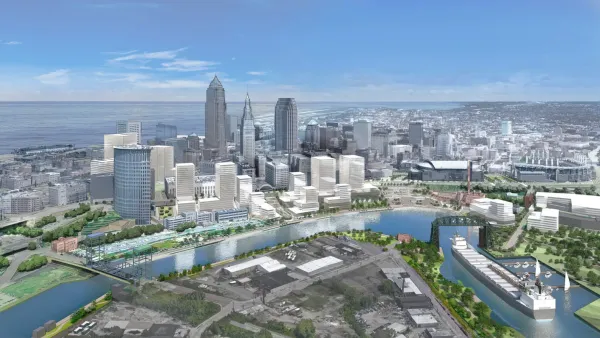
Cleveland Announces Transit-Oriented Riverfront Development
The proposed development would include 130 acres of housing, retail, and entertainment spaces.
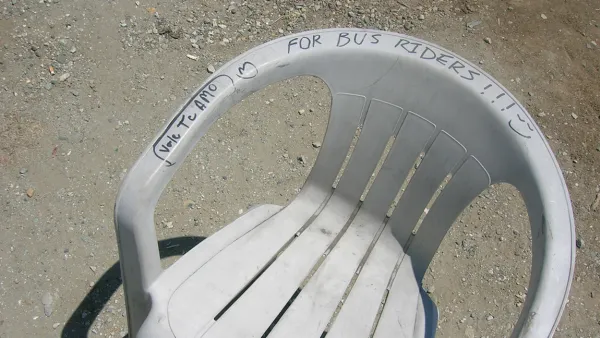
Failed Public-Private Partnership Leaves Bus Stops With No Shade in Los Angeles
A 2001 contract between the city of Los Angeles and CBS Decaux failed to deliver 662 shelters for bus stops. A case study in what not to do on either side of a public-private partnership follows.

Louisville Builds Food Hub 2.0
Unlike conventional food hubs, Louisville's planned $50 million FoodPort will gather and 'incubate' regional food businesses. The hope is to breathe life into the area's struggling small farms.
Questioning Private Investment in HOT Lanes
The 495 Express Lanes opened in Virginia in November 2012 and have yet to meet ridership projections. That might not be a problem when built by the public sector, but the road is a $1.4 billion investment by the Australian firm Transurban.
How to Turn $10 billion into $300 Billion: Create an Infrastructure Bank
It's certainly not a new idea - what's new is the current bipartisan Senate bill, cutely abbreviated as the BRIDGE Act, seeded with $10 billion of federal funds that would attract funds from the private sector to be loaned to worthy projects.
Born of Transit, a Young D.C. Neighborhood in Full Bloom
Seven years after a celebrated public-private partnership, NoMa proves a smart growth success, write Rachel MacCleery and Jonathan Tarr.
Increasingly, Infrastructure Offloaded to Private Sector
Unable to pay for transportation infrastructure and unlikely to get help at the federal level, cities and states are looking to private entities to build and invest in their infrastructure projects.
PA Turnpike Lease Saga Coming To A Head
The mother of all toll road leases appears to come to a head next month, and though the chances of the near $13 billion lease of the the 537-mile Pennsylvania Turnpike to Citigroup-Abertis team are most uncertain, the PA saga is worthy of study.

FREE Course: Walkable City 1: Why Walkability?
After describing his path towards focusing on walkability as the essence of good planning, Jeff Speck marches through his five principal reasons for making more walkable places.
Reinventing Malls: Planning Alchemy—Turning Gray Fields Into Gold
The course focuses on the opportunities and imperatives that shape reinvention of mall sites.

City of Rosemead
Rutgers University, Edward J. Bloustein School of Planning and Public Policy
One Hundred Miles
University of Michigan School for Environment and Sustainability (SEAS)
Hunter College, City University of New York (CUNY)
The Architects Foundation
City of Cambridge
Montrose County
The Pocatello Development Authority









