With billions in new federal funding set to benefit state infrastructure projects, advocates for sustainable transportation call on state leaders to focus resources on public transit, pedestrian, and cycling improvements.


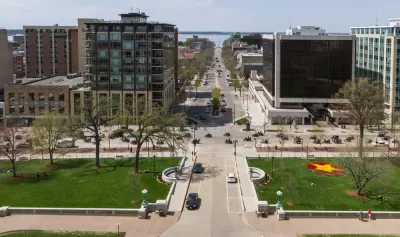
"The recently signed Infrastructure Investment and Jobs Act introduces an opportunity to rethink the structure of America’s cities. But most of the money in the infrastructure bill is designated for highway projects, even though nearly 1.2 million Wisconsinites do not drive, roughly a fifth of the population," writes Erik Pfantz in Madison Commons.
Gregg May, transportation policy director for 1000 Friends of Wisconsin, agrees. "We have almost no state funding for walking and biking. We fund transit 10% less than we did in 2006 when adjusted for inflation and it’s created a system that is really inequitable." Meanwhile, May argues, "[The] cost of car ownership is preventing a lot of people from getting jobs and the lack of transit access is harming our economic development." May points to workers who suffer long, inconsistent commutes and employers who can't find enough workers due to a lack of reliable transportation in the region.
Activists like May believe the City of Madison's recent efforts to address Vision Zero goals and improve its public transit infrastructure, if combined with new federal funding and investment and focused on equitable transportation for all residents and transportation modes, "could enable a serious transformation of the Madison area’s transportation system."
FULL STORY: Infrastructure bill funds continue to favor cars, but not everyone drives

Federal Carbon Reduction Funds Could Finance Highway Projects in Texas
Transit advocates say the state’s carbon reduction strategy reveals a continued preference for car-oriented infrastructure.
L.A. Times: California Must Shift Transportation Spending Priorities
Despite its ambitious emissions reduction goals, California continues to spend a majority of transportation funds on car-centric infrastructure.
The Business Case for Multimodal Transportation Planning
Travel demands are changing and so should planning. There are good reasons for communities to spend less on automobile facilities and more on walking, bicycling, and public transit. Let’s examine why.

Planetizen Federal Action Tracker
A weekly monitor of how Trump’s orders and actions are impacting planners and planning in America.

The state-sanctioned urbicide of Austin
People don’t kill cities. Freeways do.

US to reduce Colorado River water deliveries to Mexico
A new Colorado Treaty amendment reduces Mexico’s Colorado River water allocation by 250,000 acre feet.

5 New England states march closer to 800 megawatt wind energy project
Securing federal approval for the project may be complicated under the Trump administration, which has historically been hostile towards domestic wind power.

Baltimore to break ground on $50 million Transit Priority Project
The project will bring faster bus trips, safer streets and better bike connections to Baltimore.

Airbnb launches $250 million 'last-dollar financing' housing accelerator, makes first investment in Austin
The company will put $6.4 million towards affordable housing development in Texas’ capital.

FREE Course: Walkable City 1: Why Walkability?
After describing his path towards focusing on walkability as the essence of good planning, Jeff Speck marches through his five principal reasons for making more walkable places.
Reinventing Malls: Planning Alchemy—Turning Gray Fields Into Gold
The course focuses on the opportunities and imperatives that shape reinvention of mall sites.

Eagle County Government
Harvard University Graduate School of Design
Nashville Planning Department
The Architects Foundation
University of Cincinnati Online
The Pocatello Development Authority
The Urban Renewal Agency of the City of Pocatello
Journal of the American Planning Association