One of the best tools for understanding the consequences and potential of transit planning has been recently updated.


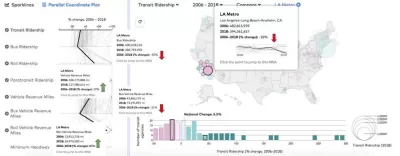
The team at TransitCenter has announced updates to the Transit Insights visual tool, which tracks the vital signs of transit: ridership, service hours, fares, and more. The update promises new data and improved usability.
As an example of the new usefulness of the Transit Insights tool, the Los Angeles County Metropolitan Transportation Authority is offered:
Take LA Metro, the main transit agency in Los Angeles. Metro’s overall vehicle revenue miles (VRM) increased 19% from 2006 to 2018. Usually people respond to greater levels of service by riding transit more, but LA Metro’s overall transit ridership actually decreased 18% during this same period.
Using Transit Insights to isolate VRM by mode, the dynamics of these contradictory trends are revealed.
Breaking down the change in service volume by mode, bus service miles actually decreased 21%, while rail increased 80%. That helps explain why bus ridership, which accounts for most trips people take on LA Metro, declined 30% over this period.
That context informs an understanding of the news that Metro L.A. in June released an updated draft of its 2020 Long Range Transportation Plan, which would invest $400 billion over 30 years in the region's transportation system.
The article includes all of the rest of the new features to be found on Transit Insights, highlighting the Orange Line on the Dallas Area Rapid Transit system (which recently restored 90 percent of its pre-pandemic service levels) for an example of how to unlock demographic insights from the tool.
FULL STORY: Say Hello to the New and Improved Transit Insights!

Newly Opened Regional Connector Redefines Light Rail Transit in Los Angeles
Three rail lines have become two rail lines in Los Angeles, providing one-seat rides from four corners of Los Angeles County.
Rail Transit Plans Would Connect L.A.’s South Bay to the Regional Rail System
Two new transit extensions promise several new routes for South Bay residents to access the Los Angeles region’s transit system.
$1.9 Billion in State Budget Surplus Requested for L.A. Transit Projects
L.A. transit officials hope the state budget surplus can be used to fund regional transit project, including one highly anticipated light rail project that broke ground on Friday, December 2.

Planetizen Federal Action Tracker
A weekly monitor of how Trump’s orders and actions are impacting planners and planning in America.

The state-sanctioned urbicide of Austin
People don’t kill cities. Freeways do.

US to reduce Colorado River water deliveries to Mexico
A new Colorado Treaty amendment reduces Mexico’s Colorado River water allocation by 250,000 acre feet.

5 New England states march closer to 800 megawatt wind energy project
Securing federal approval for the project may be complicated under the Trump administration, which has historically been hostile towards domestic wind power.

Baltimore to break ground on $50 million Transit Priority Project
The project will bring faster bus trips, safer streets and better bike connections to Baltimore.

Airbnb launches $250 million 'last-dollar financing' housing accelerator, makes first investment in Austin
The company will put $6.4 million towards affordable housing development in Texas’ capital.

FREE Course: Walkable City 1: Why Walkability?
After describing his path towards focusing on walkability as the essence of good planning, Jeff Speck marches through his five principal reasons for making more walkable places.
Reinventing Malls: Planning Alchemy—Turning Gray Fields Into Gold
The course focuses on the opportunities and imperatives that shape reinvention of mall sites.

Eagle County Government
Harvard University Graduate School of Design
Nashville Planning Department
The Architects Foundation
University of Cincinnati Online
The Pocatello Development Authority
The Urban Renewal Agency of the City of Pocatello
Journal of the American Planning Association