Three rail lines have become two rail lines in Los Angeles, providing one-seat rides from four corners of Los Angeles County.


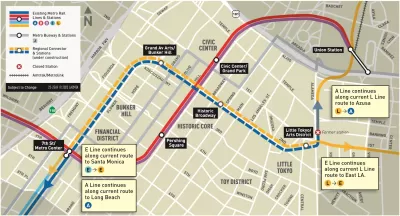
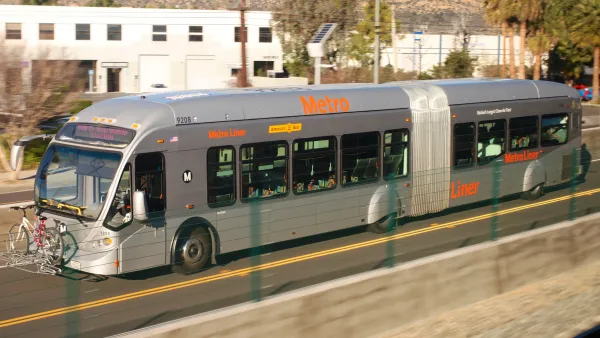
The Los Angeles County Metropolitan Transportation Authority (Metro) opened the long-awaited Regional Connector to the public on June 16, completely redrawing Metro’s rail service map in the process.
“The 1.9 miles of new track laid allows light-rail trains to travel between Union Station and the busy 7th St./Metro Center Station in downtown LA’s Financial District,” according to an article by Brandon Lewis for Mass Transit magazine. “Bridging the gap allows L.A. Metro to merge the hook-shaped L (Gold) line with the A (Blue) and E (Expo) lines, creating two serpent-like train lines where there were once three.”
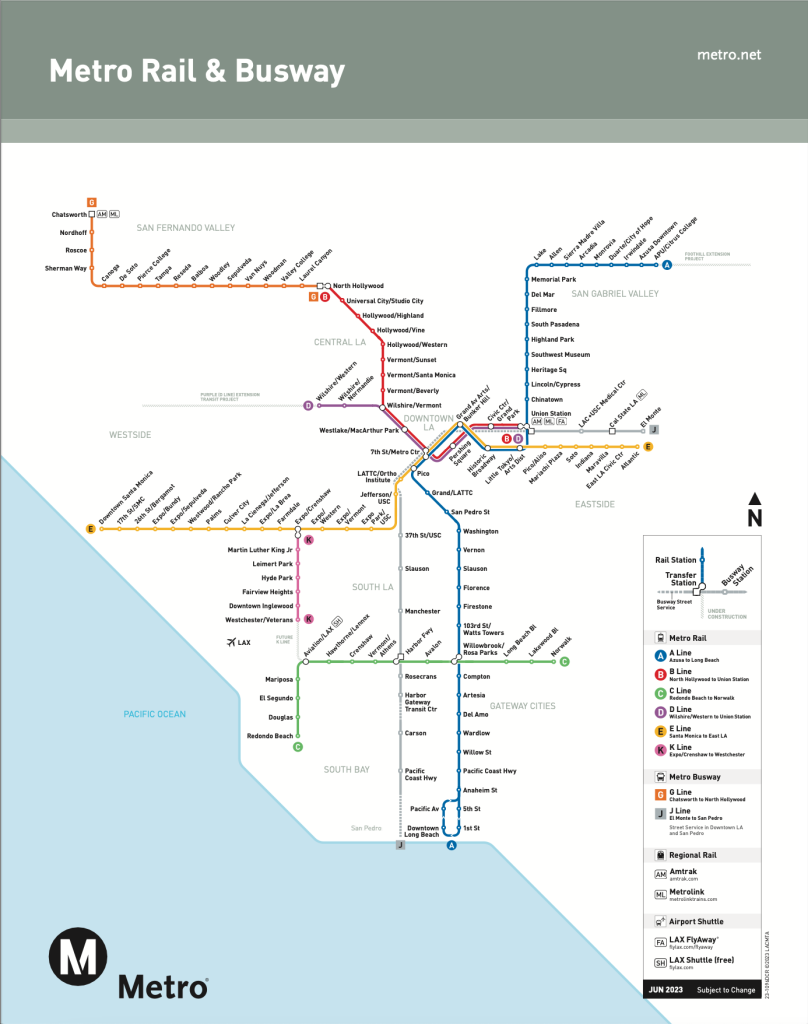
In effect, the two newly formed lines allow one-seat light rail rides from Azusa to Long Beach on the A Line, and East L.A. to Santa Monica on the E Line. The project overcame delays in 2019 and a lawsuit in 2012 to come to fruition.
The new project also delivered three new underground stations to serve the newly formed A and B lines in downtown—the Little Tokyo/Arts District Station, the Historic Broadway Station, and the Grand Avenue/Bunker Hill Station.
Local coverage of the Regional Connector’s contribution to transit in Los Angeles is available from L.A. Taco and the Los Angeles Times [paywall]. See also Metro’s Regional Connector Transit Project page for more information.
Read the full story: L.A. Metro celebrates opening of Regional Connector

Rail Transit Plans Would Connect L.A.’s South Bay to the Regional Rail System
Two new transit extensions promise several new routes for South Bay residents to access the Los Angeles region’s transit system.
$1.9 Billion in State Budget Surplus Requested for L.A. Transit Projects
L.A. transit officials hope the state budget surplus can be used to fund regional transit project, including one highly anticipated light rail project that broke ground on Friday, December 2.
Funding for Two Transit Projects Approved for the Valley in Los Angeles
Local funding for a new light rail line and upgrades to the G Line (née Orange Line) bus rapid transit route have been approved for the San Fernando Valley in Los Angeles.

Planetizen Federal Action Tracker
A weekly monitor of how Trump’s orders and actions are impacting planners and planning in America.

California plans to bury El Niño’s downpour
If the state plays its cards right, it may be able to store a billion acre-feet of El Niño’s water in aquifers.

Chicago breaks ground on $3 billion megadevelopment
The new neighborhood, titled Foundry Park, will one day host 3,700 residences.

California High-Speed Rail Authority CEO resigns after $600,000 scandal
Under Ian Choudri, the authority used taxpayer dollars to fund first class flights and trips to nightclubs.

Want to study the Missouri River? Soon, you may need unanimous approval from 10 states
Legislation would require 10 governors’ permission to study or build projects moving water outside the basin.

Desperate measures: Advocates weigh draining Lake Powell to fill Colorado River
Draining the reservoir could reduce evaporation losses by a couple hundred thousand acre-feet.

FREE Course: Walkable City 1: Why Walkability?
After describing his path towards focusing on walkability as the essence of good planning, Jeff Speck marches through his five principal reasons for making more walkable places.
Reinventing Malls: Planning Alchemy—Turning Gray Fields Into Gold
The course focuses on the opportunities and imperatives that shape reinvention of mall sites.

City of Rosemead
Rutgers University, Edward J. Bloustein School of Planning and Public Policy
One Hundred Miles
Hunter College, City University of New York (CUNY)
The Architects Foundation
University of Cincinnati Online
City of Cambridge
Montrose County
The Pocatello Development Authority