Another regional transit authority isn't as skeptical about the Hyperloop as many critics in the transit and technology press.


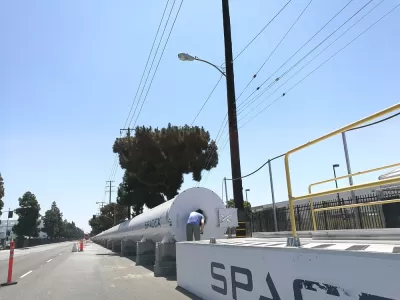
"The [Florida] Legislature appropriated an initial $1 million for the Tampa Bay Area Regional Transit Authority to take the lead in Florida in studying alternative transportation for the state, including the Elon Musk-inspired Hyperloop bullet train," reports Phil Fernandez.
The state chose TBARTA as the agency to study the Hyperloop concept, responding to requests from around the state to explore futuristic transit concepts.
Fernandez, for worth its worth, seems just as excited about the prospects of the Hyperloop as the Florida State Legislature. "Forget a boring old road," Fernandez writes.
The company tapped for the study is California TT, which is already at work with development projects already in the works overseas, as noted both in the article and on the company's website.
The proposed project in the Tampa region would track the Interstate 75 corridor, building the project in three phases. The first two phases would connect Tampa, St. Petersburg, and Bradenton, according to Fernandez. The third phased would connect Tampa to Miami going through Naples.
TBARTA joins the Northeast Ohio Areawide Coordinating Agency (NOACA) in running with the Hyperloop idea for a corridor that would connect Pittsburgh, Pennsylvania to Columbus, Ohio. Though the feasibility study for that project has faced scathing criticism for inaccuracies from the transit and technology press, Fernandez cites the study as evidence of how much the TBARTA study might cost.
Other Hyperloop planning efforts are underway in Missouri and Colorado.
The following articles are a sample of skepticism for the Hyperloop expressed over the years:
- Don't Let 'FOMO' Ruin Transportation Planning (June 2019)
- Editorial: Skip the Hyperloop—Texas Should Stick to the Basics (August 2018)
- Popping the Hyperloop Bubble (February 2018)
- Average Commute Times Won't Change Because of the Hyperloop (August 2017)
- A Boring Lesson for Planners (July 2017)
- Reality Checking Elon Musk's Hyperloop Nothing Burger—Again (June 2017)
- The Hyperloop Hype Machine (April 2017)
Read the full story: In the Know: Plans for an Elon Musk-inspired 700 mph Hyperloop bullet train for Southwest Florida; and an Aldi alert
Luxury Housing Construction and Rents on the Rise in Tampa Bay
A majority of new construction permits in the region are for high-end housing, accompanied by an increase in average rents.

Double First: The First Station on Tampa Bay's First BRT Line Complete
The first of 15 bus rapid transit stations in St. Petersburg was unveiled last week.

Tampa Bay Isn't Prepared for the Hurricanes of the Future
The area is especially vulnerable to storm surge, and increased development means more people are at risk when major hurricanes push through.

Planetizen Federal Action Tracker
A weekly monitor of how Trump’s orders and actions are impacting planners and planning in America.

Eastern Nebraska is running out of electricity
Data centers and electrification are straining eastern Nebraska’s grid, throttling economic development.

Washington state to charge fee to drivers with fuel-efficient cars
Revenue from the fee will go towards supporting the state’s highways.

Instead of building new housing, LA developers are turning mansions into mega-mansions
In the richest areas, the number of houses valued at $30 million with demolition permits has skyrocketed since 2018.

Illinois considers spending $1 billion in taxpayer money on data center
A quantum computing campus and data center are currently under construction in Chicago.

As development costs rise, Boston moves to lessen affordable housing requirements
The Boston Zoning Commission and the City Council still need to approve Boston Mayor Michelle Wu’s proposed changes

FREE Course: Walkable City 1: Why Walkability?
After describing his path towards focusing on walkability as the essence of good planning, Jeff Speck marches through his five principal reasons for making more walkable places.
Reinventing Malls: Planning Alchemy—Turning Gray Fields Into Gold
The course focuses on the opportunities and imperatives that shape reinvention of mall sites.

City of Charlotte
City of Rosemead
Rutgers University, Edward J. Bloustein School of Planning and Public Policy
University of Michigan School for Environment and Sustainability (SEAS)
Hunter College, City University of New York (CUNY)
The Architects Foundation
City of Cambridge
The Pocatello Development Authority
The Urban Renewal Agency of the City of Pocatello