With all the bad news about plummeting ridership as the D.C. Metro transit system has struggled to deal with maintenance issues, a new report indicates that regional commuters are still driving alone less.


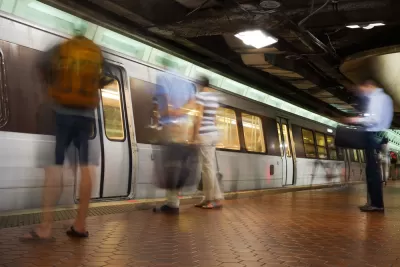
Stephen Hudson reports from the Washington, D.C. region: "In recent years, there has been no shortage of bad news about local riders fleeing transit. The Metropolitan Washington Council of Governments (COG), however, has published a report indicating that commuters are increasingly choosing transit or telework over driving."
Drive alone rates have been dropping since 2007, according to the COG's analysis. During the same period, transit, biking and walking, and teleworking have been increasing.
According to Hudson, the mode people choose to get to work in the D.C. region has a lot to do with the particular corner of the region where they live or work. "A plurality of commuters who live in the ‘inner core’ (DC, Arlington, and Alexandria) commute by transit. Likewise, 13% of commuters in the core area commute by bike, versus only 1% and 0% of commuters in the middle and outer rings, respectively."
Read the full story: Washington area commuters are driving less and using transit more

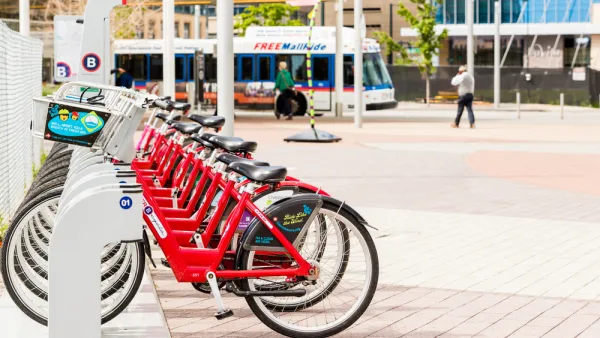
Denver Area Public Transit Ridership Dips in Favor of Car Commuting
The Downtown Commuter Survey saw an uptick in 'drive alones' among commuters who work in the city.
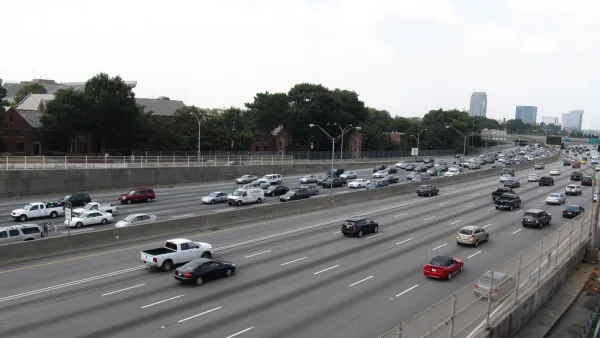
Faced With Infamously Bad Traffic, More Atlanta Residents Choose to Telecommute
More people are telecommuting in Atlanta, keeping cars of the road, but the percentages of people driving alone to work, taking transit, and walking or biking to work are holding steady.
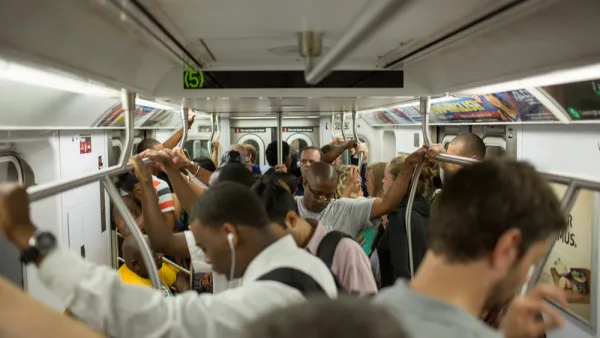
Transit's No Good, Very Bad Day
Transit commuters in New York and Washington, D.C. were understandably frustrated yesterday. One wonders when enough will be enough, and what happens then?

Planetizen Federal Action Tracker
A weekly monitor of how Trump’s orders and actions are impacting planners and planning in America.

California plans to bury El Niño’s downpour
If the state plays its cards right, it may be able to store a billion acre-feet of El Niño’s water in aquifers.

Chicago breaks ground on $3 billion megadevelopment
The new neighborhood, titled Foundry Park, will one day host 3,700 residences.

Satanic place names
From streams and lakes to valleys and canyons, I mapped more than 1,000 places named after the Devil.

California High-Speed Rail Authority CEO resigns after $600,000 scandal
Under Ian Choudri, the authority used taxpayer dollars to fund first class flights and trips to nightclubs.

Want to study the Missouri River? Soon, you may need unanimous approval from 10 states
Legislation would require 10 governors’ permission to study or build projects moving water outside the basin.

FREE Course: Walkable City 1: Why Walkability?
After describing his path towards focusing on walkability as the essence of good planning, Jeff Speck marches through his five principal reasons for making more walkable places.
Reinventing Malls: Planning Alchemy—Turning Gray Fields Into Gold
The course focuses on the opportunities and imperatives that shape reinvention of mall sites.

City of Rosemead
Rutgers University, Edward J. Bloustein School of Planning and Public Policy
One Hundred Miles
Hunter College, City University of New York (CUNY)
The Architects Foundation
University of Cincinnati Online
City of Cambridge
Montrose County
The Pocatello Development Authority