New universal design guidelines go a step beyond complete streets.


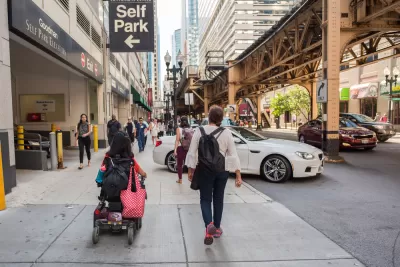
The American Society of Landscape Architects (ASLA) has published new universal design guidelines for safer streets, accessible for everyone.
"By creating this best-practices guide, ASLA is making it easier for designers from all disciplines, elected officials, and everyday people to understand what an inclusive and accessible public realm looks like. More importantly, the guidelines are a call to action," according to an article by Liz Stinson, written shortly after the ASLA published the Guidelines.
"ASLA’s universal design guidelines consider physical disabilities like limited mobility, blindness and low-vision, and Deafness and hardness of hearing; people with neuro-cognitive disorders like dementia and Alzheimer’s disease; those with neuro-developmental disabilities, like autism; and aging people. ASLA defines universal landscapes as accessible, participatory, comfortable, ecological, predictable, multi-sensory, walkable, and predictable."
Budds's coverage shares multiple insights into the concepts of universal design from Alexis Vaugh, a deaf landscape architect working for Olin, who describes access to public space as a civil right.
An earlier article by Liz Stinson originally shared the news about the ASLA's new universal design guidelines.
FULL STORY: Why inclusive cities start with safe streets

ADA Compliance Slowly Makes Headway
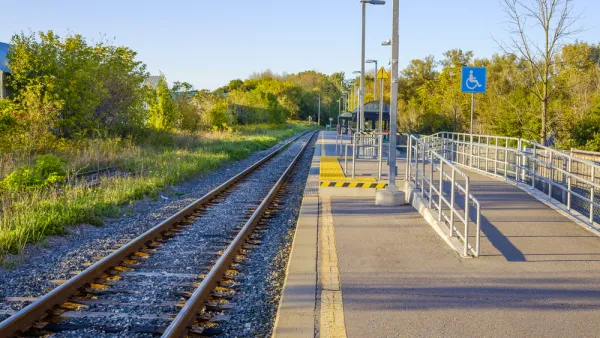
Decades of advocacy are paying off, but it often takes legal action to force cities to make accessibility improvements mandated by the Americans with Disabilities Act over thirty years ago.
How to Protect Pedestrians With Disabilities
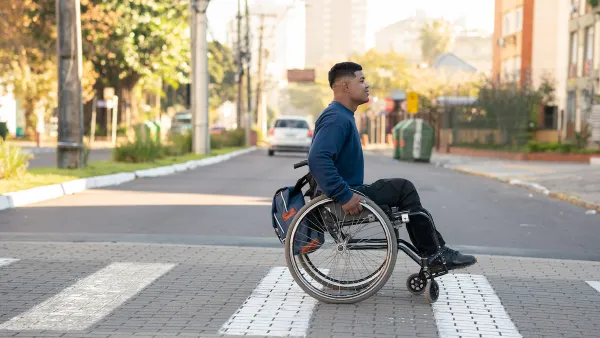
Public agencies don’t track traffic deaths and injuries involving disabled people, leaving a gap in data to guide safety interventions.
America’s 15 Most Accessible Cities
These cities are the easiest to navigate for people in wheelchairs or with mobility challenges.

Planetizen Federal Action Tracker
A weekly monitor of how Trump’s orders and actions are impacting planners and planning in America.

The state-sanctioned urbicide of Austin
People don’t kill cities. Freeways do.

US to reduce Colorado River water deliveries to Mexico
A new Colorado Treaty amendment reduces Mexico’s Colorado River water allocation by 250,000 acre feet.

5 New England states march closer to 800 megawatt wind energy project
Securing federal approval for the project may be complicated under the Trump administration, which has historically been hostile towards domestic wind power.

Baltimore to break ground on $50 million Transit Priority Project
The project will bring faster bus trips, safer streets and better bike connections to Baltimore.

Airbnb launches $250 million 'last-dollar financing' housing accelerator, makes first investment in Austin
The company will put $6.4 million towards affordable housing development in Texas’ capital.

FREE Course: Walkable City 1: Why Walkability?
After describing his path towards focusing on walkability as the essence of good planning, Jeff Speck marches through his five principal reasons for making more walkable places.
Reinventing Malls: Planning Alchemy—Turning Gray Fields Into Gold
The course focuses on the opportunities and imperatives that shape reinvention of mall sites.

Eagle County Government
Harvard University Graduate School of Design
Nashville Planning Department
The Architects Foundation
University of Cincinnati Online
The Pocatello Development Authority
The Urban Renewal Agency of the City of Pocatello
Journal of the American Planning Association