Are pedestrian walk buttons effective, or do they only give us the illusion of control? It can vary.


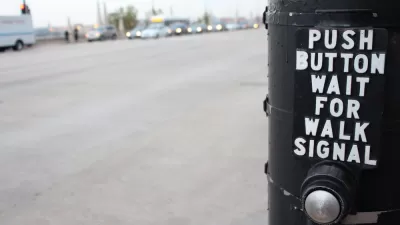
With a focus on Washington D.C., Jordan Pascale discusses what can seem like one great mystery to pedestrians: the walk button. "You generally expect something to happen when you push a button. Especially when a sign encourages you do so. But that's not generally the case with pedestrian buttons in the District. They often don't accomplish what you're hoping for: the ability to cross the street faster."
Despite the distinct sense that walk buttons only give walkers the illusion of control, the situation has improved over time. Before the rise of computerized traffic signals, Pascale writes, pedestrians often had to resort to the "beg button" to get the right-of-way. Now, traffic signals generally give D.C. pedestrians the walk sign "when it's their turn." The downside is that "if there is a push button, it generally won’t make the walk signal come faster."
Still, on some intersections, pushing the button activates audio cues for the visually impaired. And D.C. has implemented HAWK (High-intensity Activated crossWalK) signals at some mid-block crossings for the sole benefit of pedestrians.
FULL STORY: You Pushed The Walk Button At An Intersection. So Why Don’t The Cars Stop?

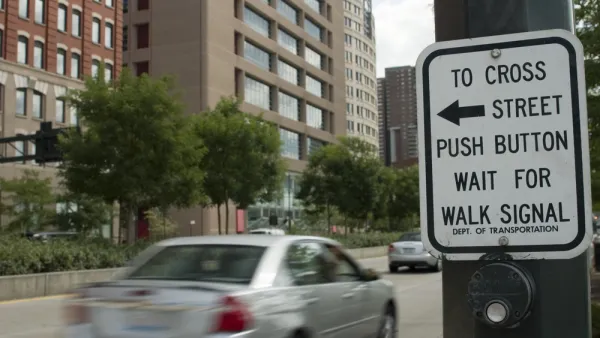
'Beg Buttons' Quietly Appearing at East Bay Crosswalks
Critics of pedestrian crosswalk buttons say the devices, meant to help improve bus speeds, give pedestrians the 'absolute lowest priority' on city streets.
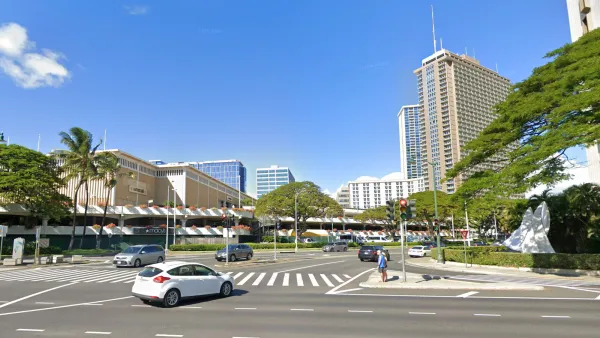
Hawaii DOT takes action after reporters call attention to dangerous crosswalk
The state made changes to a treacherous intersection after reporting revealed that traffic light timing was posting a threat to pedestrians.
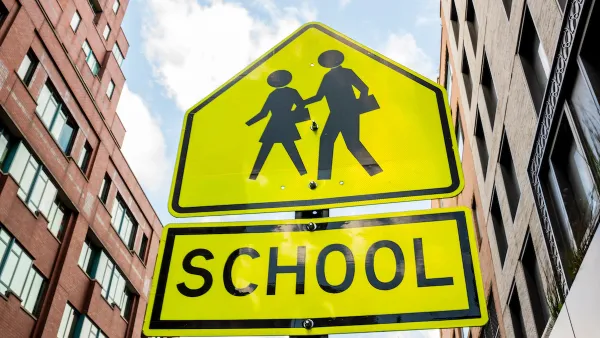
Crosswalks Near NYC Schools More Dangerous Than Average
A child and a crossing guard were killed in school crosswalks within one week as the NYPD cuts crossing guard jobs.

Planetizen Federal Action Tracker
A weekly monitor of how Trump’s orders and actions are impacting planners and planning in America.

The state-sanctioned urbicide of Austin
People don’t kill cities. Freeways do.

US to reduce Colorado River water deliveries to Mexico
A new Colorado Treaty amendment reduces Mexico’s Colorado River water allocation by 250,000 acre feet.

Airbnb launches $250 million 'last-dollar financing' housing accelerator, makes first investment in Austin
The company will put $6.4 million towards affordable housing development in Texas’ capital.

Guerilla urbanists are building DIY bus stop benches in Chicago
A before-and-after of one of the bus stops with a new bench. The new benches are not officially sanctioned or permitted, but the residents who placed them hope they will be the start of a network of DIY benches across the city.

Mamdani overhauls NYC's Vision Zero plan with 100 new policy goals
The overhaul aims to reduce traffic deaths and make streets safer for pedestrians, cyclists and drivers through lower speed limits, new safety infrastructure and more.

FREE Course: Walkable City 1: Why Walkability?
After describing his path towards focusing on walkability as the essence of good planning, Jeff Speck marches through his five principal reasons for making more walkable places.
Reinventing Malls: Planning Alchemy—Turning Gray Fields Into Gold
The course focuses on the opportunities and imperatives that shape reinvention of mall sites.

Eagle County Government
Harvard University Graduate School of Design
Nashville Planning Department
The Architects Foundation
University of Cincinnati Online
The Pocatello Development Authority
The Urban Renewal Agency of the City of Pocatello
Journal of the American Planning Association