A Vision Zero program in Los Angeles is memorializing the tragedies of traffic collisions at 100 locations around the city.


Laura J. Nelson reports on a new program in the city of Los Angels that is installing "rainbow halos" at locations where drivers, pedestrians, and people on bikes have been killed in traffic collisions.
The first rainbow halo to be installed will commemorate the death of Conor Lynch, who was killed by a driver in 2010 while crossing the street in the neighborhood of Sherman Oaks.
"Nearly a decade later, the intersection where he died has a new feature: a vivid, multicolored disc, about the size of a dinner plate, that casts a rainbow shadow across the pavement and a green bus bench that bears his photo," writes Nelson.
Nearly 100 memorials are scheduled for installation, reports Nelson, in the hopes of raising awareness about traffic safety in addition to memorializing tragedies.
"After Lynch’s memorial was installed, city crews added halos at crash sites in Sunland, Vermont Square and Del Rey. Others are planned in Frogtown, Shadow Hills, Wilmington, Silver Lake and Carthay. At some intersections that have seen multiple deaths, the halos could honor several people," explains Nelson.
"The public art project is part of Vision Zero, Mayor Eric Garcetti’s initiative to eliminate traffic deaths on Los Angeles streets by 2025," according to Nelson. Vision Zero is under new scrutiny in many cities, where traffic fatalities are still increasing despite the stated goals of Vision Zero efforts. In Los Angeles, fatal car crashes increased between 2018 and 2015, the latter being the year Los Angeles Mayor Eric Garcetti adopted the city's Vision Zero policy. So far this year, fatalities have dropped by 1 percent from this time a year ago.
Read the full story: 100 rainbow ‘halos’ on Los Angeles street corners will honor people killed in car crashes


Big Cities Make Pedestrian Safety a Priority
New data released Dec. 19 by NHTSA shows increased safety for those traveling by car, but pedestrian fatalities are 15% higher than in 2009. Plans by San Francisco, Los Angeles, New York, and Chicago to increase ped safety are described by the WSJ.
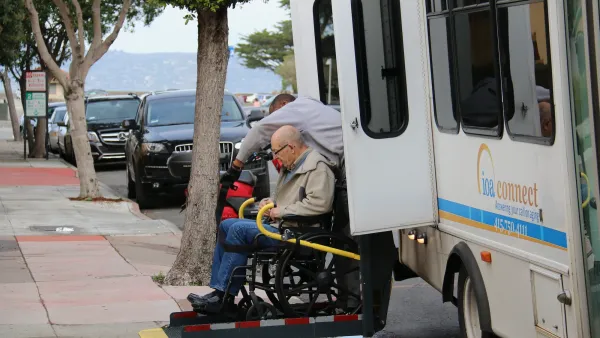
Seniors Account for 32% of Traffic Deaths in the Bay Area
Road safety interventions would help protect seniors and other vulnerable groups from traffic violence.
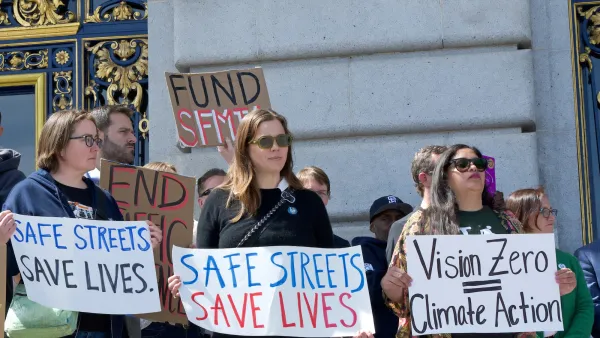
San Francisco Cut Traffic Deaths Almost in Half in 2025
The city credits its Vision Zero strategy and new traffic cameras for reducing the number of deaths and serious injuries on its roads.

Planetizen Federal Action Tracker
A weekly monitor of how Trump’s orders and actions are impacting planners and planning in America.

The state-sanctioned urbicide of Austin
People don’t kill cities. Freeways do.

US to reduce Colorado River water deliveries to Mexico
A new Colorado Treaty amendment reduces Mexico’s Colorado River water allocation by 250,000 acre feet.

Nation's most wind-powered state turns to coal as data centers increase energy demand
For the first time in decades, Iowa has increased its generation of coal power.

NYC cools commuters with city's first rain garden above a bus stop
New York City officials say the plants in the rain garden can absorb 16 gallons of rainwater during heavy storms.

Brightline West’s future may rely on $6 billion federal loan
The company has until Nov. 2 to make a $400 million equity investment into its proposed high-speed rail line.

FREE Course: Walkable City 1: Why Walkability?
After describing his path towards focusing on walkability as the essence of good planning, Jeff Speck marches through his five principal reasons for making more walkable places.
Reinventing Malls: Planning Alchemy—Turning Gray Fields Into Gold
The course focuses on the opportunities and imperatives that shape reinvention of mall sites.

Greater Baltimore Committee
Eagle County Government
Harvard University Graduate School of Design
The Architects Foundation
University of Cincinnati Online
The Pocatello Development Authority
The Urban Renewal Agency of the City of Pocatello
Journal of the American Planning Association