President Trump has not been a friend to the $30 billion Gateway Program, a transportation project meant to replace aging rail infrastructure connecting New York and New Jersey.


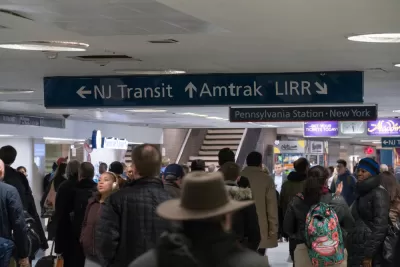
"The Gateway Program is a transportation project intended to fix the crumbling infrastructure carrying roughly 200,000 daily of commuters between New Jersey and New York through the Hudson River Tunnel," Adriana Belmonte writes. As such, many see it as critical to a well-functioning national economy.
State, local, and congressional stakeholders are seemingly onboard. However, as we've seen, President Trump has resisted the provision of federal funding for the project, reportedly using it as a political bargaining chip in his conflicts with Democrats over the border wall and other issues.
Inaction on the project could have national consequences. "A recent report from the Regional Plan Association warned that a partial Hudson River Tunnel shutdown without a new tunnel 'would cost the national economy $16 billion, reduce home values by $22 billion, and lead to decreased economic productivity, job losses, increased congestion, and crashes across the northeastern United States.'"
See also:
Read the full story: The Trump administration is holding up a crucial infrastructure project


Funding Approved for Key Rail Connection Between New Jersey and New York
The Portal Bridge is a key component of the larger Gateway Program that includes tunnels under the Hudson River. Fixing the Portal Bridge across the Hackensack River will provide tremendous relief to NJ Transit and Amtrak commuters.
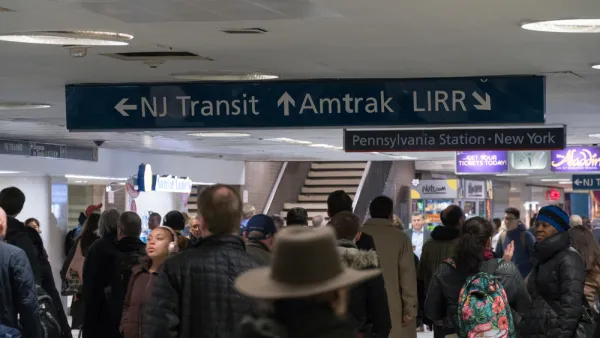
Biden Would Finally Get the Gateway Project Moving, Advocates Say
A group of regional experts and advocates provide details on how a win by former Vice President Joe Biden might change the direction of the Gateway Project to repair the rail link between New Jersey and New York.
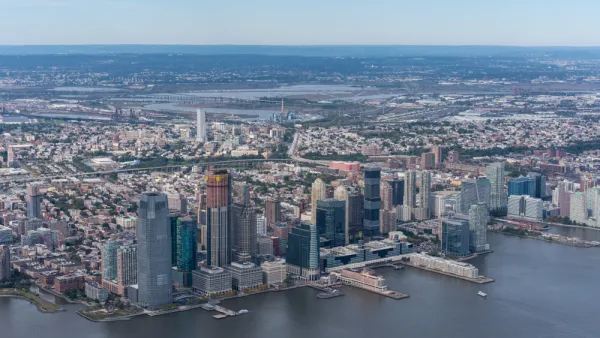
Costs, Delays Ballon on Hudson River Tunnel Project
Developers are baling the latest delays and cost increases for the Hudson Tunnel Project on uncertainty surrounding federal environmental review.

Planetizen Federal Action Tracker
A weekly monitor of how Trump’s orders and actions are impacting planners and planning in America.

California plans to bury El Niño’s downpour
If the state plays its cards right, it may be able to store a billion acre-feet of El Niño’s water in aquifers.

Chicago breaks ground on $3 billion megadevelopment
The new neighborhood, titled Foundry Park, will one day host 3,700 residences.

California High-Speed Rail Authority CEO resigns after $600,000 scandal
Under Ian Choudri, the authority used taxpayer dollars to fund first class flights and trips to nightclubs.

Want to study the Missouri River? Soon, you may need unanimous approval from 10 states
Legislation would require 10 governors’ permission to study or build projects moving water outside the basin.

Desperate measures: Advocates weigh draining Lake Powell to fill Colorado River
Draining the reservoir could reduce evaporation losses by a couple hundred thousand acre-feet.

FREE Course: Walkable City 1: Why Walkability?
After describing his path towards focusing on walkability as the essence of good planning, Jeff Speck marches through his five principal reasons for making more walkable places.
Reinventing Malls: Planning Alchemy—Turning Gray Fields Into Gold
The course focuses on the opportunities and imperatives that shape reinvention of mall sites.

City of Rosemead
Rutgers University, Edward J. Bloustein School of Planning and Public Policy
One Hundred Miles
Hunter College, City University of New York (CUNY)
The Architects Foundation
University of Cincinnati Online
City of Cambridge
Montrose County
The Pocatello Development Authority