Do residents in Vancouver, Washington need protection from congestion pricing applied to all lanes on two Portland interstates? Gov. Jay Inslee seems to think so, adding that the value pricing pilot project is "going nowhere."


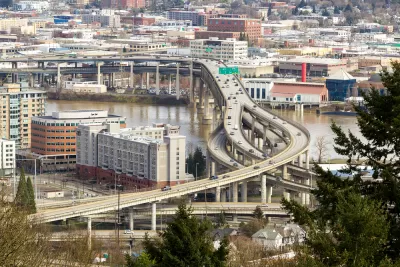
Gov. Jay Insee (D) has been a champion of fighting climate change and addressing transportation shortfalls, as has Oregon's Gov. Kate Brown (D). Both governors have signed transportation funding legislation that hikes gas taxes. One measure in the Oregon law, HB 2017, impacts Vancouver, the largest suburb of Portland, that has Inslee concerned.
Inslee instructed the Washington State Department of Transportation on Tuesday "to make sure our residents’ interests are protected in any tolling discussion," reports Katy Sword for The Columbian.
It's not like Washington residents, or even WSDOT wasn't heard by the Portland Metro Area Value Pricing Policy Advisory Committee which forwarded its recommendations to the Oregon Transportation Commission (OTC) on July 5.
The 25-member committee — of which Vancouver Mayor Anne McEnerny-Ogle, Clark County Councilor Eileen Quiring and WSDOT Southwest Regional Administrator Kris Strickler were members — suggested pursuing Concept B, which would toll all lanes in I-5 between Southwest Multnomah Boulevard and Northeast Going Street. The group also recommended moving forward with Concept E, which would add tolls on I-205 near the Abernathy Bridge and Stafford Road.
Sword updates the recommendations with information not previously posted here:
Earlier [in July], however, the Portland City Council told the OTC they prefer skipping the first phase and moving ahead with tolling all lanes of I-5 and I-205, a proposal known as Concept C. The advisory committee suggested considering a full rollout after testing tolls on a smaller scale to ensure success.
Inslee scoffed at the recommendations, stating on Tuesday that "the proposal is 'going nowhere,'” adds Sword. Clearly, they are going somewhere – to the OTC, and from there to the Federal Highway Administration by Dec. 31, as required by HB 2017 [pdf]. What happens from there is another story.
Washington congresswoman welcomes Inslee's comments
Rep. Jaime Herrera Beutler, R-Battle Ground, tweeted that she was "pleased to hear Inslee stand up for the best interests of Southwest Washington [and state] that Oregon’s tolls at state line 'will not happen'" after earlier tweeting that the Democratic governor should "take a public stand alongside me against unfair tolling that would penalize Washington commuters once they crossed the state line." In a July 31 press release, Beutler added:
Defending working class Washington residents is not a Republican or a Democrat issue, it’s what elected officials are supposed to do, and I hope more of our colleagues who represent this region join us and publicly weigh in against Oregon’s plan.”
Hat tip to IBTTA Smart Brief.
FULL STORY: Inslee weighs in on 1-5, I-205 tolls proposed by Oregon

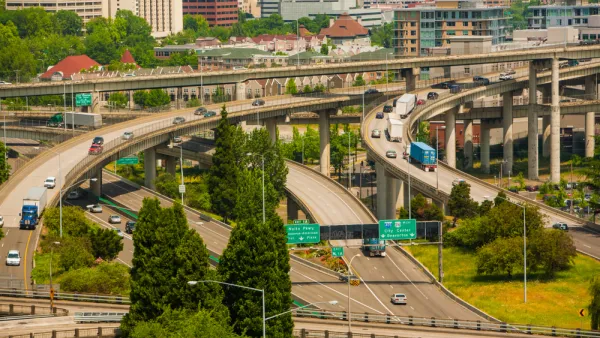
Interstate Highway Tolling Takes Major Step Forward in Pacific Northwest
The state that implemented the first gas tax and the first bike tax took a huge step on Thursday toward becoming the first, since 1956, to toll all lanes on an interstate highway by approving an application to the Federal Highway Administration.
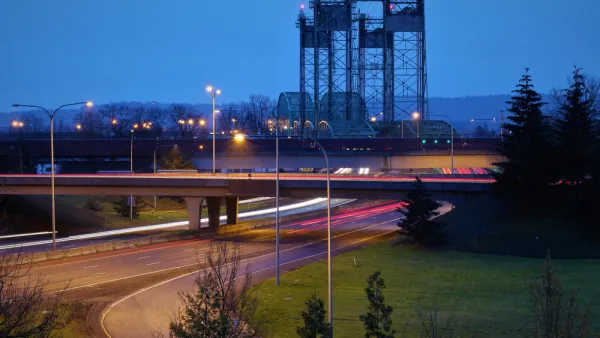
Priced Lane or Priced Roadway?
The Pacific Northwest's Portland-Vancouver metropolitan area is studying options to add congestion pricing to one or two interstates.
Portland's Regional Congestion Pricing Program Widens and Advances
It might be the nation's most significant but least known congestion pricing plan. The plan originally recommended tolling all lanes on segments of two interstates. Four more roads were just added to broaden the plan.

Planetizen Federal Action Tracker
A weekly monitor of how Trump’s orders and actions are impacting planners and planning in America.

The state-sanctioned urbicide of Austin
People don’t kill cities. Freeways do.

US to reduce Colorado River water deliveries to Mexico
A new Colorado Treaty amendment reduces Mexico’s Colorado River water allocation by 250,000 acre feet.

5 New England states march closer to 800 megawatt wind energy project
Securing federal approval for the project may be complicated under the Trump administration, which has historically been hostile towards domestic wind power.

Baltimore to break ground on $50 million Transit Priority Project
The project will bring faster bus trips, safer streets and better bike connections to Baltimore.

Airbnb launches $250 million 'last-dollar financing' housing accelerator, makes first investment in Austin
The company will put $6.4 million towards affordable housing development in Texas’ capital.

FREE Course: Walkable City 1: Why Walkability?
After describing his path towards focusing on walkability as the essence of good planning, Jeff Speck marches through his five principal reasons for making more walkable places.
Reinventing Malls: Planning Alchemy—Turning Gray Fields Into Gold
The course focuses on the opportunities and imperatives that shape reinvention of mall sites.

Eagle County Government
Harvard University Graduate School of Design
Nashville Planning Department
The Architects Foundation
University of Cincinnati Online
The Pocatello Development Authority
The Urban Renewal Agency of the City of Pocatello
Journal of the American Planning Association