Friday may have been disgraced EPA Administrator Scott Pruitt's last day in office of the agency in charge of protecting the nation's environment, but he still managed to roll back a regulation to create lasting air pollution far greater than VW did.


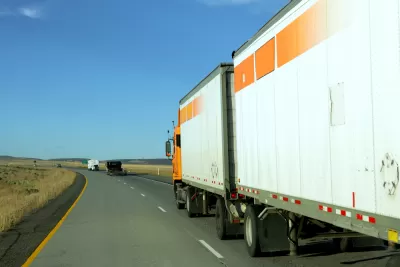
U.S. Environmental Protection Agency Administrator Scott Pruitt's resignation did not take effect Friday, as posted here earlier, but rather by "close of business" on Friday, just long enough to do more lasting harm to air quality and public health and benefit a manufacturer (and campaign contributor) of what are called "glider trucks," new trucks with old engines, by repealing another Obama-era regulation, reports Eric Lipton of The New York Times on July 6.
The glider truck concept began so the engines of relatively new trucks that had been involved in accidents could be transferred to new truck bodies. But as the emissions control requirements went into effect in recent years, companies like Fitzgerald Glider Kits of Crossville, Tenn., began to attract thousands of buyers from around the United States — including many small fleet owners — that wanted to evade the new rules, getting trucks they argued were cheaper to run.
"From the outside, a glider looks like any other modern Peterbilt, Kenworth, Freightliner, or Western Star semi tractor," wrote researchers Rachel Muncrief and Josh Miller for the International Council on Clean Transportation on Dec. 1, 2017. But look under the hood and things start to get terrifying. Inside you will find an engine that was thought to be long dead—an engine that emits uncontrolled levels of nitrogen oxides (NOx) and particulate matter (PM)."
ICCT, working with West Virginia University, was responsible for exposing the Volkswagon emissions testing cheating almost three years ago, which Lipton references by way of comparison:
One year’s worth of truck sales was estimated to release 13 times as much nitrogen oxide as all of the Volkswagen diesel cars with fraudulent emissions controls, a scheme that resulted in a criminal case against the company and more than $4 billion in fines.
By contrast, "NOx and PM emissions from modern diesel engines are more than 90% below what they were 15 years ago, thanks to EPA regulations," add ICCT's Muncrief and Miller.
Congressional and industry opposition
"Members of Congress on both sides of the aisle have written three letters to Environmental Protection Agency Administrator Scott Pruitt asking him to reconsider his proposal to repeal an Obama administration regulation that would limit the number of glider kits manufactured each year," reported Eric Miller for Transport Topics on April 15.
The repeal of the regulation (via a loophole) created strange bedfellows, with the mainstream trucking industry standing with the environmental community.
"The continued growth of gliders creates a competitive disadvantage to fleets purchasing new equipment and circumvents today’s stringent emissions standards for PM, NOx and greenhouse gases," testified [pdf] Glen Kedzie for the American Trucking Associations at a hearing on EPA's proposed repeal of emission requirements for glider vehicles, glider engines, and glider kits rule on Dec. 4, 2017.
Some conservative media outlets focused on costs rather than emissions.
"Glider kits became an incredibly important source of trucks for small companies unable to afford newer engines, especially in the wake of Clinton administration trucking regulations that went into full effect in 2010," reported Michael Bastasch for The Daily Caller on May 2.
“The new truck industry, led by foreign-owned Volvo Trucks (whose largest shareholder is a Chinese company), lobbied the Obama EPA to ensnare us in an ongoing rulemaking to establish emissions standards for new trucks,” wrote Tommy Fitzgerald, Sr., CEO of Fitzgerald Glider Kits, in an op-ed for The Daily Caller.
Pruitt may be gone, but his replacement was party to the decision
"Vickie Patton, the general counsel at the Environmental Defense Fund, blamed both Mr. Pruitt and Andrew Wheeler, the No. 2 official at the E.P.A. who will become its acting administrator [on July 9]," adds Lipton.
“Pruitt and Wheeler are creating a loophole for super polluting freight trucks that will fill our children’s lungs with toxic diesel pollution, ignoring public comments from moms and leading businesses across the country,” she said.
FULL STORY: ‘Super Polluting’ Trucks Receive Loophole on Pruitt’s Last Day


When Academic Research Goes Bad
A 'misconduct investigation' decided that an industry-funded study, used by the EPA as the basis to roll back a regulation limiting the number of old engines that could be used in new truck chassis (i.e., "glider trucks"), was inaccurate.

Rollback of a Different Kind, Ordered by the EPA, Will Benefit Air Quality
The U.S. Environmental Protection Agency, acting at the behest of the new acting EPA administrator, will keep Obama-era regulation limiting air pollution from heavy trucks in place.
Making Older Coal Power Plants More Efficient Without Making Them Cleaner
At the center of the EPA's newly proposed Affordable Clean Energy rule is doing away with a permitting process known as New Source Review that requires coal power plants to add scrubbers and other expensive pollution control equipment when upgraded.

The state-sanctioned urbicide of Austin
People don’t kill cities. Freeways do.

US to reduce Colorado River water deliveries to Mexico
A new Colorado Treaty amendment reduces Mexico’s Colorado River water allocation by 250,000 acre feet.

New Jersey’s second-largest city bans standalone data centers
Jersey City will continue to allow co-location facilities, such as those meant for research institutions that store their own data.

Amtrak not solely to blame for New Jersey commuter rail's unreliability, report finds
A new study from the Garden State Initiative found that NJ Transit’s budget grew 20% across a 4 year period, but reliability declined significantly over the same period.

EPA erases limits on planet-warming pollution from power plants
Under Monday’s plan, power plants would still have some limits on how much mercury, arsenic and other contaminants they can emit.

Phoenix announces new on-demand transit service, more frequent RAPID buses
Both new services will launch in October, and are part of Phoenix's Project Effective Access Solutions for Easing Congestion.

FREE Course: Walkable City 1: Why Walkability?
After describing his path towards focusing on walkability as the essence of good planning, Jeff Speck marches through his five principal reasons for making more walkable places.
Reinventing Malls: Planning Alchemy—Turning Gray Fields Into Gold
The course focuses on the opportunities and imperatives that shape reinvention of mall sites.

Eagle County Government
Harvard University Graduate School of Design
Nashville Planning Department
The Architects Foundation
University of Cincinnati Online
The Pocatello Development Authority
The Urban Renewal Agency of the City of Pocatello
Journal of the American Planning Association