Entitled tech bros! Disrupted sidewalks! Mass impound sweeps! Social media convulsions!



"San Francisco's city attorney on Monday issued a cease and desist order for the unlawful operation of scooters in the city," reports Cornell Barnard.
The companies on the receiving end of those cease and desist order: Bird, Lime, and Spin.
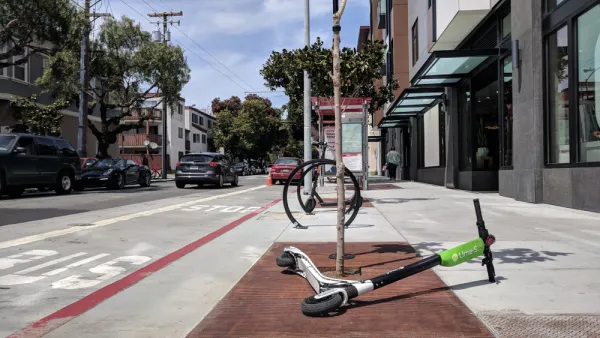
Late last week, Michael Cabanatuan reported that the city's Public Works Department had impounded 66 of the scooters and fined the companies for blocking the sidewalk. The three companies deposited the scooters onto city streets just weeks ago.
For a flavor of the public complaints about the scooters, see an article by Adam Brinklow, who crowd sources social media for photos of "scooters behaving badly."
Finally, Megan Rose Dickey reports on the status of an effort by the city to develop regulations for the e-scooter rental companies."The San Francisco Board of Supervisors’ Land Use and Transportation Committee has been working with the San Francisco Municipal Transportation Agency to develop a permit process to enable the SFMTA to regulate e-scooter share companies," according to Dickey. The next step will be to take the proposed legislation to the Board of Supervisors.
Read the full story: Electric scooters are getting closer to regulation in SF

Scooter War Now a Scooter Competition
Three scooter companies, Lime, Bird and Spin, removed their scooters from the sidewalks of San Francisco earlier this month and applied, with nine other companies, for five permits to operate up to 2,500 scooters in a tightly regulated pilot program.

New Chapter in the San Francisco Scooter Wars: Removal
The city attorney vows to bring order to the streets (and sidewalks) of San Francisco by requiring electric scooter share companies to apply for permits. First step: all e-scooters must be removed by June 4, or risk a $100 fine per day per scooter.
San Diego Merchants Call for Halt to Dockless Bikeshare Operations
Public bikeshare arrived in San Diego in 2014. Last month, three companies unleashed thousands of dockless bikes, cluttering sidewalks in three business districts to the chagrin of merchants who want a time-out so the city can develop regulations.

Planetizen Federal Action Tracker
A weekly monitor of how Trump’s orders and actions are impacting planners and planning in America.

California plans to bury El Niño’s downpour
If the state plays its cards right, it may be able to store a billion acre-feet of El Niño’s water in aquifers.

Chicago breaks ground on $3 billion megadevelopment
The new neighborhood, titled Foundry Park, will one day host 3,700 residences.

Satanic place names
From streams and lakes to valleys and canyons, I mapped more than 1,000 places named after the Devil.

California High-Speed Rail Authority CEO resigns after $600,000 scandal
Under Ian Choudri, the authority used taxpayer dollars to fund first class flights and trips to nightclubs.

Want to study the Missouri River? Soon, you may need unanimous approval from 10 states
Legislation would require 10 governors’ permission to study or build projects moving water outside the basin.

FREE Course: Walkable City 1: Why Walkability?
After describing his path towards focusing on walkability as the essence of good planning, Jeff Speck marches through his five principal reasons for making more walkable places.
Reinventing Malls: Planning Alchemy—Turning Gray Fields Into Gold
The course focuses on the opportunities and imperatives that shape reinvention of mall sites.

City of Rosemead
Rutgers University, Edward J. Bloustein School of Planning and Public Policy
One Hundred Miles
Hunter College, City University of New York (CUNY)
The Architects Foundation
University of Cincinnati Online
City of Cambridge
Montrose County
The Pocatello Development Authority