Environment
Regional Plan Recommends Three Elements for Creating a Thriving Northeast Ohio
Northeast Ohio's largest regional planning effort in a generation recommends infill development, transit expansion, and land conservation as the essential elements for ensuring the area's future success.
Strict Standards for Ship Emissions Cleanse Bay Area Air
Thanks to a Calif. law implemented in 2008 requiring ocean-going ships to switch from high-sulfur bunker fuel to cleaner fuels within 24 miles of the coast, Bay Area air quality significantly improved by reducing deadly particulate emissions.
Architects of Green Dorm Ban Mini-Fridges, Microwaves
Perkins + Will, the architecture firm behind a new residence hall at Bridgewater State University, have attached an unusual provision to their green design: no mini-fridges or personal microwaves allowed.
CEQA Reform: The Year in Review
Three groups review the final bill (also known as Kings Arena bill) that reformed California's landmark, but controversial 1970 environmental law known as CEQA: CA Economic Summit, NRDC and Climate Plan. All credit the author, Sen. Darrell Steinberg.
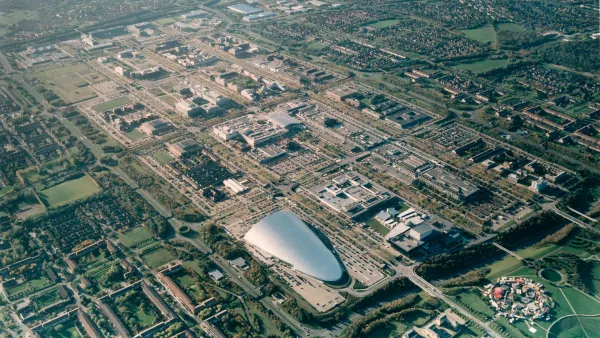
The UK’s Most Infamous ‘New Town’ Pioneers a Food System Revolution
Urban agriculture is a promising solution to a variety of ills afflicting our increasingly urbanizing planet. Milton Keynes, Britain's largest New Town of the 20th Century, is forging a path towards food sovereignty by growing its urban farms.
The United (Watershed) States of America
What if the great adventurer and geographer John Wesley Powell had his way: That as the western states were brought into the union their shape would be dictated by watershed rather than political boundary? This blog - and map - depict this scenario.
Prius Founder Questions Future of Electric Vehicles
Toyota Motor Corp. Chairman Takeshi Uchiyamada, who helped develop the world's most popular hybrid-electric vehicle, questioned the ability of pure electric vehicles to supplant petroleum-fueled vehicles because of battery and charging challenges.
California Becomes More EV-Friendly With 6 New Laws
Gov. Jerry Brown showed his support for electric vehicles (EVs), clean air, and reducing carbon emissions with the signing of six bills. In addition to EVs, all clean cars will benefit, including plug-in hybrids, FCVs and natural gas-powered.
Disaster or Dodged Bullet? Colorado Debates Environmental Impact of Floods
What was the extent of the environmental damage caused by leaking oil wells during September's flood? Turns out, it depends on whom you ask. Word from both government and the industry is that it was minimal, while environmental advocates disagree.
Science Takes a Back Seat to Canada's "Resource Rush"
In an editorial for The New York Times, Verlyn Klinkenborg bemoans the Harper administration's silencing of scientists in favor of political ideology, resource extraction, and public ignorance.
Top 10 Civic-Minded Companies
A ranking of the 10 most civic-minded companies holds some surprises -- mainly that the list is dominated by financial services firms.
Sustainability Initiatives Pay Green Dividends for S.F. Schools
Five years after San Francisco hired its first sustainability director for the city's school system, the controversial decision is paying off in environmental benefits and substantial energy savings.
Developing a Block-by-Block Understanding of the Impacts of Climate Change
The best models of the impacts of climate change have been devoted to understanding global, or even national, changes. But NASA has devoted significant computational resources to projecting future climate conditions at the neighborhood level.
Award-Winning Project Imagines Insects Will Solve Urban Hunger
A team of Canadian MBA students has won $1 million to alleviate urban hunger with insect-based foods, reports Mary Jander.
New Yorkers Breathe Easier as the City's Buildings Clean Up Their Act
A Bloomberg administration effort to get New York's most polluting buildings to convert to cleaner heating fuels has provided remarkable results, a new study reports.
In Sobering Report, U.N. Climate Panel Establishes “Carbon Budget” for Humanity
The synopsis of the IPCC's fifth major climate assessment was released today in Stockholm. With near absolute certainty, the panel identified humans as the cause of the dangerously warming planet. Could the report propel languishing negotiations?
Synthetic Natural Gas will be China's (and the World's) Climate Nightmare
China's drive to reduce urban air pollution and increase energy security will unleash massive carbon and toxic emissions, almost tripling its current emissions over 40 years. The plan is to build 40 plants to convert coal to synthetic natural gas.
Why Affordable Housing is an Environmental Issue
Improving our cities and suburbs is just as important to environmental sustainability as regulating pollution or conserving undeveloped land, argues Kaid Benfield.
10 Cities Most at Risk From Natural Disasters
Natural disasters affect millions of people each year, and cost between $60 billion and $100 billion worldwide. Here are the 10 global cities most at risk.
Cut Emissions to Save Lives, If Not the Planet
Even if our warming planet wasn't threatened with environmental catastrophe, the case for reducing fossil-fuel use is an easy one to make. A new study shows that reduced air pollution from cutting emissions would save millions of lives by 2100.

FREE Course: Walkable City 1: Why Walkability?
After describing his path towards focusing on walkability as the essence of good planning, Jeff Speck marches through his five principal reasons for making more walkable places.
Reinventing Malls: Planning Alchemy—Turning Gray Fields Into Gold
The course focuses on the opportunities and imperatives that shape reinvention of mall sites.

City of Rosemead
Rutgers University, Edward J. Bloustein School of Planning and Public Policy
One Hundred Miles
University of Michigan School for Environment and Sustainability (SEAS)
Hunter College, City University of New York (CUNY)
The Architects Foundation
City of Cambridge
The Pocatello Development Authority
The Urban Renewal Agency of the City of Pocatello









