Kaid Benfield spotlights an innovative federal program that is "not very well known but deserves to be." The "Greening America’s Capitals" program aims to make America's state capitals showpieces for green infrastructure and green building practices.


Launched in 2010 by the EPA with their cohorts in the federal Partnership for Sustainable Communities, Greening America’s Capitals awards funding and design assistance to three to five state capitals every year in order to "develop an implementable vision of distinctive, environmentally friendly neighborhoods that incorporate innovative green building and green infrastructure strategies," and to "inspire state leaders to expand this work elsewhere."
Benfield reports from Hartford, one of the five initial cities selected for the Greening America’s Capitals program, where a team led by Nelson Byrd Woltz created a strong vision [PDF] for infusing the city with green infrastructure. The only problem is that Benfield had a hard time finding anyone in Hartford who'd heard of the promising plan, or were engaged in its development. This seems to be a serious problem for a program that is intended to focus on implementability and catalyzing wider change.
"Someone at the [EPA] needs to take a closer look [at the program]," says Benfield, "because this could be the case in other cities involved in the program, too: these are terrific designs and recommendations, but it's not enough to have terrific designs and recommendations if you want the program to make a real difference."
"Put more positively," he continues, "this is a truly excellent report that deserves to be publicized, discussed, supported by leaders and the public and, to the greatest degree possible, implemented."
Read the full story: Greening America's capital cities
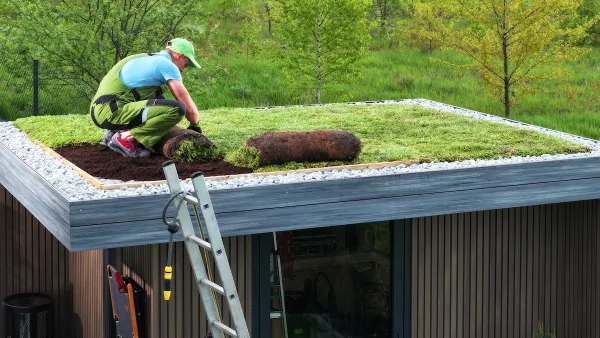
The next era of climate resilience will be measured in co-benefits
Why the strongest resilience investments solve more than one problem at once.
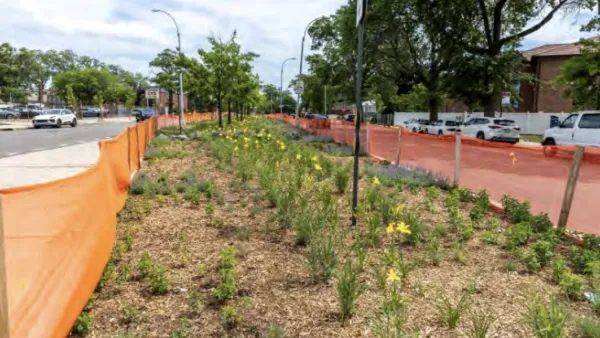
New NYC ‘sponge’ medians will absorb 5 million gallons of stormwater per year
The project will turn three medians in Queens into green infrastructure designed to absorb stormwater.
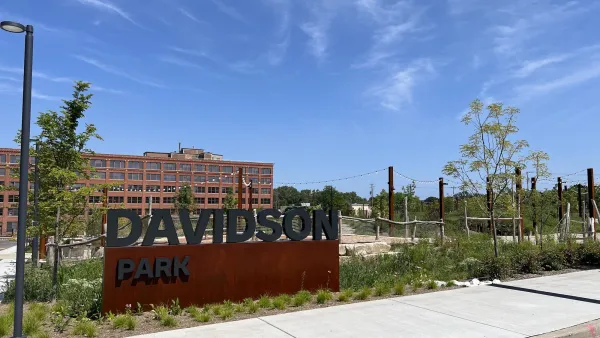
Harley-Davidson turned a Milwaukee parking lot into a green oasis
The park, adjacent to Harley-Davidson headquarters, doubles as stormwater retention infrastructure.

Planetizen Federal Action Tracker
A weekly monitor of how Trump’s orders and actions are impacting planners and planning in America.

California plans to bury El Niño’s downpour
If the state plays its cards right, it may be able to store a billion acre-feet of El Niño’s water in aquifers.

Desperate measures: Advocates weigh draining Lake Powell to fill Colorado River
Draining the reservoir could reduce evaporation losses by a couple hundred thousand acre-feet.

Post election, Texas is no longer Musk’s 'AI oasis'
Elon Musk dolled out $446 million on the 2026 midterms, the most ever spent by a non-canidate.

Chicago voters approve permanent festival grounds, penalty for vacant property owners
Currently, major summer and fall festivals take over public parks for weeks at a time, drawing criticism from nearby residents

NYC votes to cut outdoor dining red tape, speed up permitting
New York City also voted to allow the Department of Transportation to begin work on urgent projects before notifying elected officials.

FREE Course: Walkable City 1: Why Walkability?
After describing his path towards focusing on walkability as the essence of good planning, Jeff Speck marches through his five principal reasons for making more walkable places.
Reinventing Malls: Planning Alchemy—Turning Gray Fields Into Gold
The course focuses on the opportunities and imperatives that shape reinvention of mall sites.

City of Rosemead
Rutgers University, Edward J. Bloustein School of Planning and Public Policy
One Hundred Miles
Hunter College, City University of New York (CUNY)
The Architects Foundation
University of Cincinnati Online
City of Cambridge
Montrose County
The Pocatello Development Authority