California
If Rail Crossings Can't Be Grade Separated, Can They At Least Be Safer?
That's the question asked by legislation introduced after a Metro-North commuter train slammed into an SUV at a crossing in Valhalla, N.Y., killing six people. More than 200 people die annually in over 2,000 grade crossing crashes.
Proposal Would Make an Urban Agriculture Incentive Zone for Santa Clara County
The county of Santa Clara is exploring the possibility of establishing an Urban Agriculture Incentive Zone—a relatively new land use incentive enabled by recent statewide legislation.
Change of Venue for Denver's Transit CEO: Los Angeles
Phillip Washington will leave his role as CEO of the Denver Regional Transportation District to take the same position at the Los Angeles County Metropolitan Transportation Authority.
Where Have All the Oil Trains in California Gone?
While many California were protesting oil trains carrying the hazardous Bakken crude, a funny thing happened—they stopped coming. While protests may have delayed the construction of new oil terminals, economics is at the root of the slowdown.
How Los Angeles Will Update its 1946 Zoning Code
Tom Rothmann explains how and why Los Angeles is updating antiquated language governing land use in the city.
From the Golden Gate Bridge: How Many Bikers Is Too Many Bikers?
A city councilmember in Sausalito in the North San Francisco Bay Area is ready to limit the number of tourists riding rental bikes into her city from across the Golden Gate Bridge.
SB 32 to Pick Up Where AB 32 Leaves Off
California's landmark climate legislation, AB 32, ends in five years; i.e., the target year for emissions reduction is 2020, after which there will be no comparable legislation targeting a future year. SB 32 sets emission reduction goals for 2050.
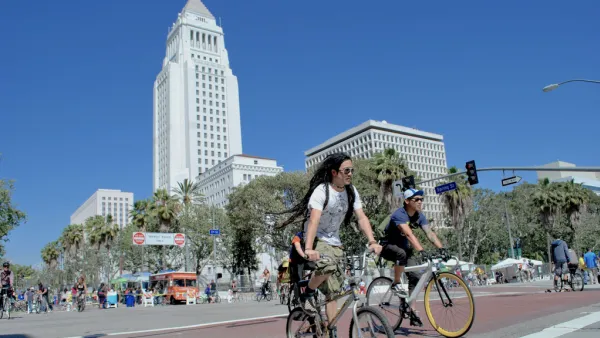
On the Re-Orientation of Los Angeles
Aaron Paley, the man who brought Ciclovia to the United States, wants Los Angeles to be a model for the transition from auto-dependent to car-optional.
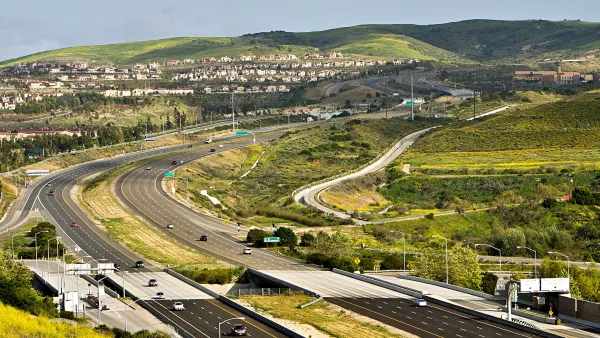
A Pedestrian's Perspective on Sprawling Orange County
Southern California's Orange County isn't exactly known for its walkability. Frank H. Wu decided to test that notion on a recent carless visit.

Los Angeles and the Getty Launch Historic Places Database
Confirmed: Los Angeles really does have a rich history. HistoricPlacesLA, a new online database, provides detailed information on the city's historic sites.
San Francisco Resets the Bar with New Online Approvals Database
The online documentation of the San Francisco Planning Department's approval process received a huge upgrade.
Los Angeles' Plan to Minimize Displacement During Urban Revitalization
Bloomberg Philanthropies will fund an "Innovation Delivery Team" in Los Angeles to approach the challenge of revitalizing urban neighborhoods while also creating improvements for existing populations.
A 'Good News' Air Pollution Study for a Change
Too often we report on new studies showing how air pollution worsens public health, often causing premature death. For a change, here's a study showing how efforts to improve air quality in Southern California have boosted public health in children.
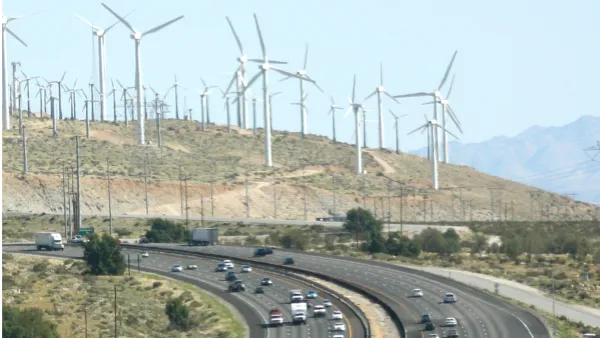
Op-ed: "Fix-It-First" is California's New Infrastructure Policy
In this San Francisco Chronicle Open Forum, Brian Kelly, secretary of the California State Transportation Agency, makes the case that maintenance as well as capital costs be included when financing new infrastructure projects.

How Driverless Cars Could Affect Suburban Land Use
Successful driverless cars might lead to "mini mass transit," a distinct mode from public transit and the private automobile. The consequences for land use could reshape suburbia.
Evaluating California's SB 375 Implementation So Far
Julie Pierce, city of Clayton councilmember, chair of the Contra Costa Transportation Authority, and president of the Association of Bay Area Governments, evaluates the effects of SB 375, California's key land use law to address climate change .
Exploring the Planning History of Downtown Oakland
Oakland, as the urban counterpart to San Francisco in the Bay Area, is on a lot of people's radar as a place to improve on some of the lessons of recent waves of urbanization. What planning precedents shaped the city on the other side of the Bay?
Plastic Bag Ban to Be Decided by Referendum in California
Thanks to a vigorous signature gathering effort bankrolled by the American Progressive Bag Alliance, a bill signed by Gov. Jerry Brown last September that outlawed single-use plastic bags will be decided by the electorate in November 2016.
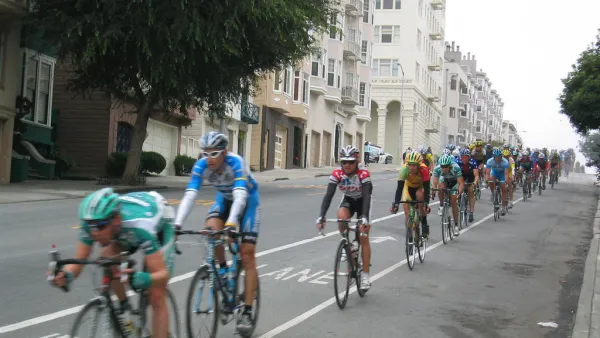
America's Best Bike Lane May Finally Earn the Title
The San Francisco Municipal Transportation Agency voted 6-0 on March 3 to approve a controversial plan to redesign 1.3 miles of Polk Street, one of the most dangerous corridors for biking and walking in The City. It only took 2.5 years.
Palo Alto Stalls on Controversial Measure to Cap Commercial Development
In some places, it might be hard to imagine even considering a cap on the development of commercial development. Palo Alto, home to Stanford University and a hot bed of California's tech industry, did just that in City Council earlier this week.

FREE Course: Walkable City 1: Why Walkability?
After describing his path towards focusing on walkability as the essence of good planning, Jeff Speck marches through his five principal reasons for making more walkable places.
Reinventing Malls: Planning Alchemy—Turning Gray Fields Into Gold
The course focuses on the opportunities and imperatives that shape reinvention of mall sites.

City of Rosemead
Rutgers University, Edward J. Bloustein School of Planning and Public Policy
One Hundred Miles
University of Michigan School for Environment and Sustainability (SEAS)
Hunter College, City University of New York (CUNY)
The Architects Foundation
City of Cambridge
Montrose County
The Pocatello Development Authority









